


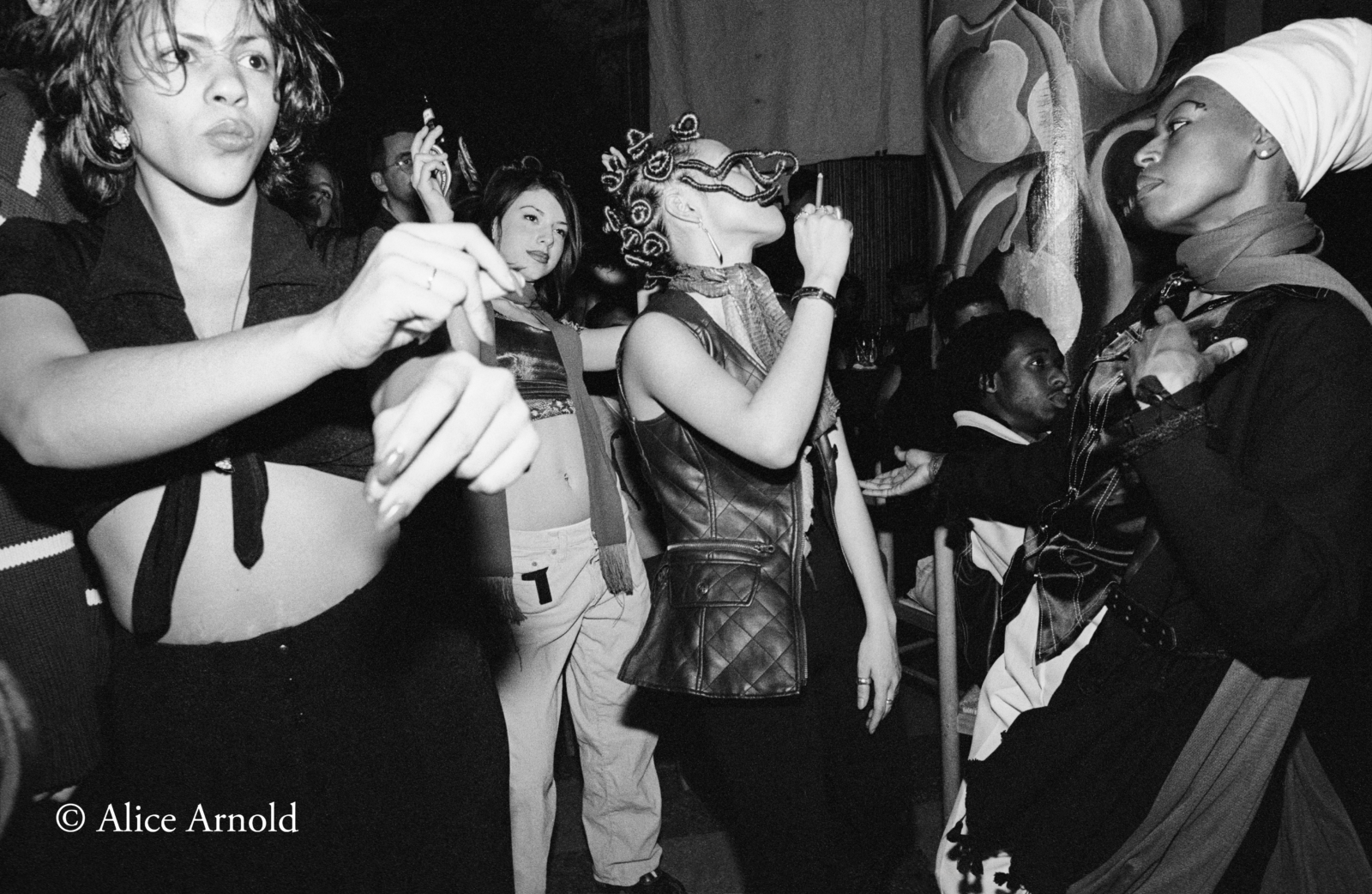
It’s been thirty-five years since I first met photographer Alice Arnold at a Lower East Side meeting for the British magazine Soul Underground. It was the winter of 1990, and at the time, I wrote about music for the downtown tabloid Cover, but was trying to break into other publications. Soul Underground covered rap, jazz, Chicago House, Detroit Techno, and various post-Garage/Larry Levan dance scenes. I’d cold-called Soul Underground’s editor, and, after ten minutes of chatter, he invited me to his crib for a meeting regarding the next issue.
Soon after I arrived at the meeting, a short white woman carrying a camera bag showed up. That was Alice. The soft-spoken Los Angeles native had only lived in New York a short time. She spoke shyly and our host made introductions. While Alice had been a photo assistant back home in California, that work was mostly movie star and fashion celebrity portraits in which the up-and-coming artist had little interest. She’d moved to New York City because of its proximity to music magazines and hip hop culture. Alice was a fan of jazz, soul, and dance, and wanted to document the various artists and scenes.
“Back in California, I had heard some hip hop music on the radio one night that really intrigued me,” Arnold told me via email in the summer of 2022. “It was a mix by [1980s hip hop producer] Mark The 45 King. I sort of followed that sound. What I liked about 45 King productions was the rhythm, which was driven by funk and soul music that I heard growing up, but the music was also in the now, with electronic overtones and a collage of layered sounds. It seemed that something interesting and exciting was going on in pop culture and I wanted to be around that.”
I’d been a photography enthusiast since I was a boy. I’d grown up reading photo credits in magazines and knew Richard Avedon, Gordon Parks, and Francesco Scavullo well. I could see the world of commercial photography was a man’s world. Except for Annie Leibovitz and Lynn Goldsmith, I don’t recall women’s names on credits in Rolling Stone, Crawdaddy, or Creem. Hip hop culture wasn’t the great equalizer when it came to women photographers, but a few in the early years paved the way. Martha Cooper captured graffiti artists in 1984’s Subway Art, a collaboration with fellow photographer Henry Chalfant. Janette Beckman shot for British publications Melody Maker and The Face as well as album covers for indie-rap labels Next Plateau, Sleeping Bag, and Profile.
Alice shot more in venues and clubs, capturing candid images of both the performer and the audience. Her pictures reproduced the action of musicians playing, crowds swaying, and the heat of the moment. She was determined to leave her mark without biting anyone’s style, approaching each photo shoot with the same level of confidence and skill that MC Lyte rocked the mic. Though she later photographed writer Octavia Butler and late jazzy soundtrack maestro Lalo Schifrin, it was her soulful, rap-related images in the 1990s that stayed with me.
* * *
In ’80s America, only a few magazines featured rap artists regularly. Those that did, including Right On! and Word Up!, were mostly written and edited by women: Cynthia Horner, Kate Ferguson, Gerrie Summers. The photographers were usually men. Alice arrived on the scene a decade later, just as the printscape of “urban” magazines was about to expand and the glass ceiling was about to crack. Other women photographers began to shoot hip hop, including Sue Kwon, Lisa Leone, Rachelle Clinton, and Stella Magloire. I was most drawn to Alice’s candid style.
Alice was still working as an assistant to a prominent photographer when we first met, while I was slaving by day at a family homeless shelter’s recreation department. That evening, I walked Alice to her Avenue A storefront that had been converted into an apartment. “The LES was raw and rough when I moved here,” she says. “There was a lot of open drug dealing, homeless people and a general level of danger. I was always on my guard walking home from a gig at night. It was also a vibrant multicultural neighborhood, and it was inspiring to be in that mix. At that time rents were cheap and I had a lot of friends who lived around here, so that made one feel connected to a community.”
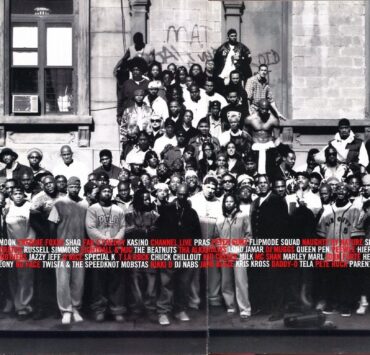
I became a regular visitor, and we’d talk for hours over wine and cheese. She showed me her work and schooled me on the jazz photographers who were her creative guides: William Claxton, Chuck Stewart, and Art Kane, whose well-known 1958 photo of famous jazz musicians in Harlem hung on her wall. “I think I was most influenced by reportage street photographers like Cartier-Bresson, William Klein, and Robert Frank,” she says. “They showed me that this [music] was a significant subject and that gave me courage to pursue it.”
Our first collaboration was neither hip hop nor jazz, but instead a feature for Soul Underground on the artists down with the Black Rock Coalition, an organization founded by Village Voice writer Greg Tate and Living Colour guitarist Vernon Reid. The arts organization sponsored concerts and held “cult-nat freaky-deke” events. It was like the Harlem Renaissance, but with guitars.
My story highlighted the various artists I dug including the blaring soulful rock guitarist Jean-Paul Bourelly, a Chicago native whose sound was blues-based. Bourelly was performing at the Knitting Factory, which was about ten blocks away from Alice’s flat.
Alice and I walked from her place and talked about our mutual love for music. In the car as a child her young ears were tuned to the sounds of Motown and later, into her teen years, David Bowie and Led Zeppelin. “That led me to explore blues music, the roots of rock n’ roll,” she remembered, “and from there I got interested in jazz. Blue Note album covers were a big part of me getting pulled into the music. Their design ethos made me want to listen and absorb the style.” While the Blue Note art director was Reid Miles, many of their classic covers were shot primarily by cofounder Francis Wolff.
Bourelly stood about 6’3 and was laidback and humorous until he got on stage. He was a powerful performer whose fiery sound mixed various genres with the straight-up blues he’d heard in his native Chicago. Alice took shots before the show and while Bourelly performed, capturing the electric energy that seemed to surge through him when he played. Unlike today, there were no instant images. Alice used a manual Nikon 35mm camera or a Hasselblad; there were times when she used an old Speed Graphic camera or the Mamiya medium format cameras.
“I spent a lot of creative time in the darkroom making prints,” she said recently. “Seeing the image appear in the developing tray is a magical experience.” That first year in the city she also shot the KRS-One cover of the debut issue of The Source. Considered the first “serious” rap magazine, it paved the way for Rap Pages, Vibe, XXL and numerous other hip hop journals published through the ’90s, many of which eventually published Alice’s work.
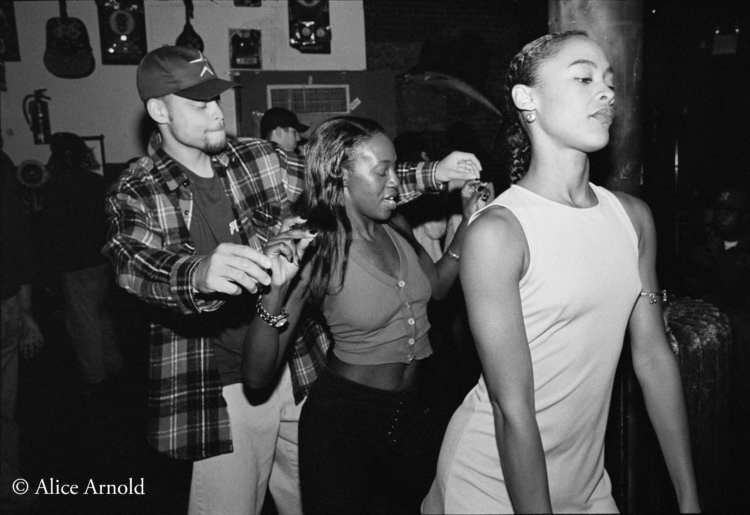
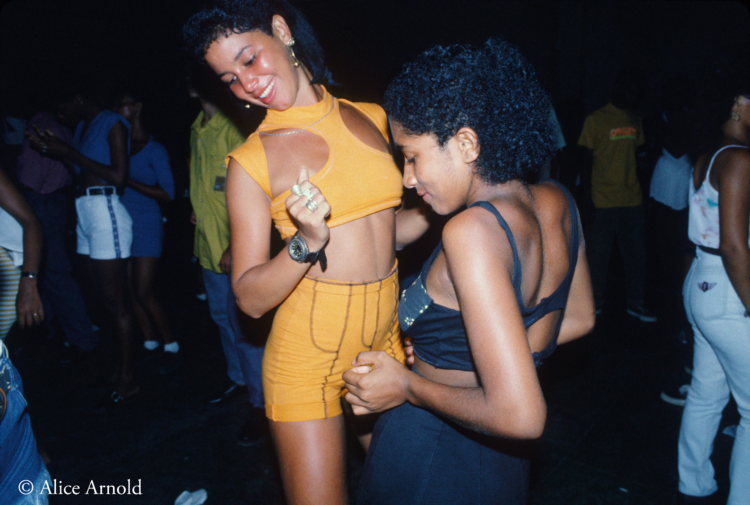
Not long after we met, Alice introduced me to the Giant Step/Groove Academy parties that were held at various locations including S.O.B.’s, Metropolis Café and Sweet Jane, and it was love at first boogie. “I thought there was something visually and sociologically interesting in the underground club world that should be represented,” Alice said.
For the multiracial folks who partied there, Giant Step was as important as The Electric Circus and Slugs in the ’60s, Max’s Kansas City and CBGB’s in the ’70s, Danceteria and the Garage in the ’80s.
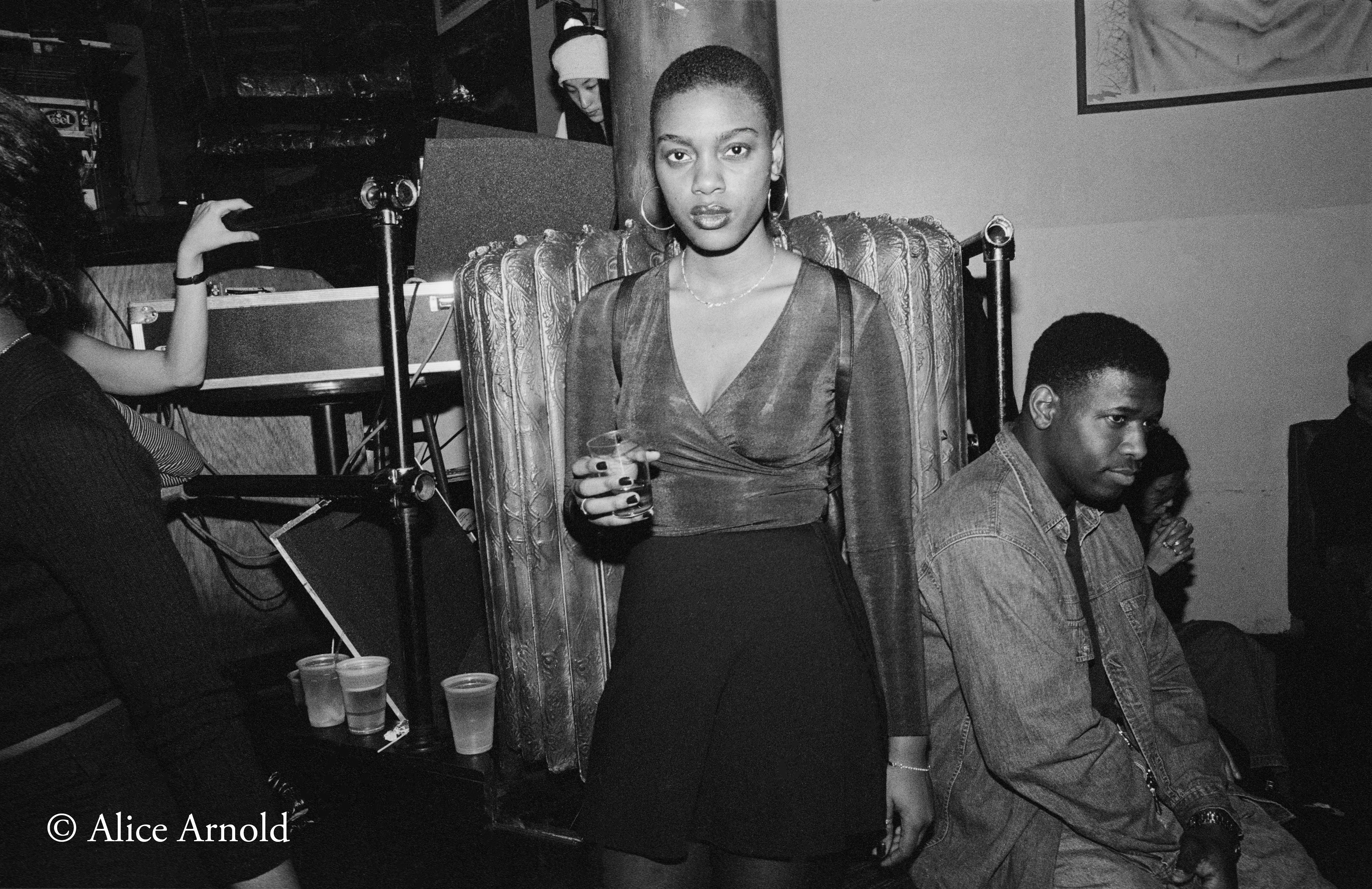
While I’d long been known as the dude holding up the wall, Giant Step’s blend of old school soul from my youth and then budding retro rhythm lovers A Tribe Called Quest, Brand New Heavies, and Gang Starr drew me to the dance floor. Later I learned that the records were played on the ones-and-twos by DJs Jazzy Nice and Smash while a posse of live musicians who called themselves the Groove Collective played.
Flexible dancers embraced the rhythms, their arms reaching towards the ceiling, their hands fluttering like small wings as they tried to take flight over live drums and flute. Whenever Alice was in the house, she mingled with the people, taking pictures. “I never liked the term ‘acid jazz,’” she said. “But it was an attempt at describing a mixing together of jazz and hip hop with a contemporary sense of style.”
Years after those parties were over, I still think about those smoky, vibrant nights.
* * *
From October 1990 to the spring of 1991, my friend Havelock Nelson and I worked on Bring the Noise: A Guide to Rap Music and Hip hop Culture, one of the first rap books by Black authors who’d grown up in and around the culture. We picked the photographers: Ernie Paniccioli, Tina Paul and Alice, who supplied shots of X Clan, 3rd Bass, the Jungle Brothers, and “Kris” Parker, known by most as KRS-One. All the photos were special, but my personal favorite was the one of KRS-One.
Anyone who has ever listened to his albums knew that Kris was a big talker. Having christened himself “The Teacher,” he was constantly preaching. But in Alice’s picture he sat peacefully in front of a storefront, hands folded, lost in thought. What he was contemplating is anyone’s guess, but the iconic image reminded me of Rodin’s famous statue, “The Thinker.”
Alice also took my author’s photo. I believe that was the first time I was her subject; pictures from that shoot were later published in Essence. We worked together often over the next decade. While ’90s urban culture has been heavily documented in books, films and exhibits, little has been written about Arnold’s extensive work during that period. As a writer who “was there” in the beginning of her career, I’ve decided to make the world remember Alice’s contributions to hip hop. Over the course of a few days, we exchanged emails and turned back the hands of time.
* * *
Michael A. Gonzales: Kicking off the ’90s, I recall your KRS-One photo on the cover of The Source. That was just as the magazine was about to go national.
Alice Arnold: Editor-in-Chief (and then co-owner) Jon Shecter hired me. Someone I know must have introduced me to him. I actually was not aware of The Source before that point, but I remember being told that this would be their first NYC issue and it was a big deal at the time to do the cover shoot. There was a video shoot that was going on at the same time, so there certainly was some planning for the day, but this was all done by the people at the magazine.
I showed up with my Nikon 35mm and Hasselblad. The cover photo is with the Hassy. This was the first time I met KRS and he was so inspiring to be around. He was also fun to photograph, because he liked to interact with the photographer and he was also, from my impression, very conscious about the importance of crafting an image that would align with his musical message. Still, he was not a control freak about his appearance. We shot in various locations in Greenwich Village including the West 4th Street basketball court and Washington Square Park. I got a short moment with KRS alone to photograph him in the park, near one of the George Washington statues. That was where the cover shoot, using the Hassy, took place. I photographed him many times in the early-mid ’90s after that shoot and he always remembered me. He had a nickname for me: Model Eyes. He was fun to photograph, because he was willing to try things.
MG: You shot rapper and Real World (season one) cast member Heather B. for my late friend photo editor George Pitts, the man who defined the visual aspect of Vibe magazine from 1993 to 2004. What was it like working with him and her?
AA: I first met George Pitts when he was a photo editor at Entertainment Weekly. What I remember most about him is that he liked to talk about images. He was deeply immersed in visual culture and he sat down with photographers to talk to them. I remember talking to George when he was at Entertainment Weekly about my hip hop and reportage youth culture photographs (including the club images). He was very interested in these subculture images. Shortly after my first Entertainment Weekly job he became the photo director of the newly launched Vibe.
Heather B. was so much fun to photograph, but I don’t think she had a big career as a hip hop artist, so these images have not been widely seen. She had a lot of energy and style and really collaborated in the photo process. The latter I think is really key to making interesting images of people. There should be an exchange, some spark of energy on both sides of the lens.
MG: In terms of style, what do you think set you apart from other photographers of your generation?
AA: I think I became a photographer because I wanted to have a greater understanding about people and learn about the world in general. I did not have one style, as I tried to experiment and also to craft an aesthetic for each particular job—content that fit the person and the context. I would say my work isn’t flashy, extravagant, or heavily stylized. I want my portrait images to be thoughtful and piercing. For my reportage, I think a lot about composition and how to utilize the frame. I seek to create very active compositions that include elements cropped at the frame edges. I think about what is in the frame and what is not in the frame. I think about what I want to say or show about a certain situation and try to frame the images to express the emotion of what it feels like to be in that place at that time.
MG: Shooting for magazines in the ’90s, did you have a lot of input on which images were used?
AA: I worked for a lot of European music magazines and in these situations I did have a lot of freedom about image selection. In those pre-digital days, this was mainly because there wasn’t turnaround time for an editor to make selections and order prints, so I did it and FedExed them off. When working for clients in New York, like The New York Times, The Village Voice, or Vibe, the photo editors would decide which images would run. Usually, I sent them marked up contact sheets, so they knew what my selects were.
Two issues that many photographers faced back then was getting their materials back and getting paid. I’ve been burned by many small magazines and record labels, in terms of not getting paid and or not getting images back. These are the reasons why photographers would no longer work for a client.
MG: You shot Missy Elliott in 1999 for her label, The Goldmind. What was she like as a young artist? What was the difference between shooting for the record company and shooting for magazines?
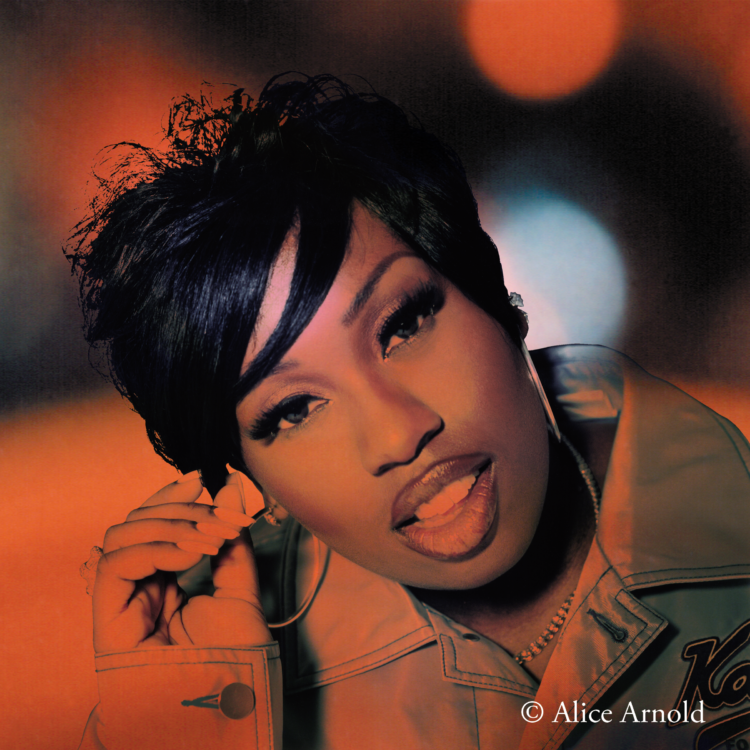
AA: I was hired by BMG in Germany to photograph Missy for press photos. I flew out to LA for the job, thinking I was going to have some quality time with her, but in reality I got around fifteen minutes. The location was a photo studio that was set up already and it was teeming with photographers, all waiting for their moment with her. I remember thinking what a pro she was, posing for photographers all day long. That took discipline and drive, to make each of these sessions feel spontaneous and special.
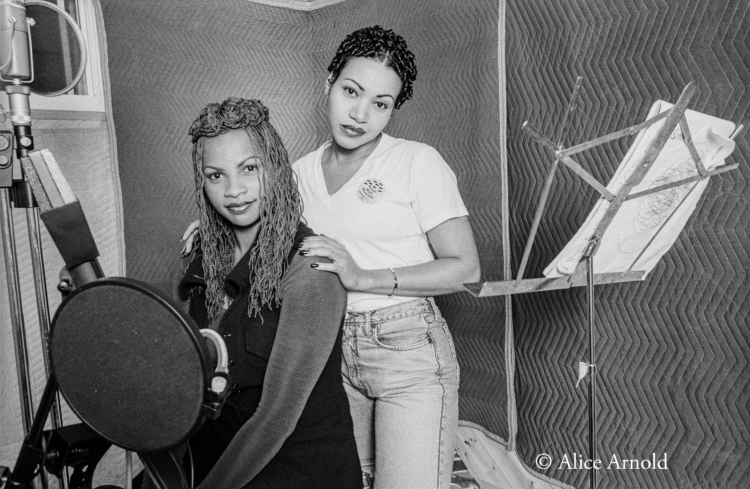
I also met up with her in a recording studio and have some photos of her working. It’s nice to photograph artists when they’re young and still somewhat new to the process of show business. They haven’t been photographed a zillion times, so the whole process and the attention is exciting for them. There’s also a different balance of power in the relationship between the photographer and the artist. Older, more established artists can be more controlling of their image and more closed off to trying new things.
MG: Shooting Salt-N-Pepa for Rolling Stone must’ve been a career triumph. What do you recall about the shoot?
AA: I did a few jobs for Rolling Stone, but yeah, working for them was cool, because of their history and caché. I liked working with their photo editors, because they let the photographers produce the shoot and create the images. I was jazzed when I got the job to photograph Salt-N-Pepa, because they are classic hip hop artists. The photo shoot was in Long Island, in one of their homes, which had a recording studio in it, so that’s where the shoot took place. Unlike the Missy shoot, this one was not rushed and they gave me a lot of their time. They were lovely to work with.
MG: What was the most challenging aspect of shooting hip hop artists in the 1990s?
AA: Photographing hip hop artists was often challenging. Some artists, like KRS-One, were great, but others were not respectful of the process. I’m referring mainly to the press day photo sessions where the record labels or public relations agencies set up a full day of magazine shoots and interviews for artists. These were so often difficult, because artists would not show up or show up late or were not wholehearted participants. These actions could really affect the quality of the image.
Also, I think as a woman, and a white person, I was often tested. For example, I was on a shoot once for a music video and one of the artists pulled a gun on me. I didn’t flinch, so his buddies started laughing at him. It was no joke to me and I was very shaken up by this incident. With the popularity of gangsta rap in the mid-90s, hip hop became rougher and more misogynistic. My experience with some of these artists definitely involved sexism and this led me to being less interested in rap music and the hip hop scene. Still, I don’t think bad behavior was particular to hip hop artists; rock n’ roll groups could also be jerks.
Sex and race were big issues then as now. For the business side, dealing with photo and art directors, I think there was a color line, just as there was in the music industry at that time. There was a division between “white” and “Black” music within the pop music industry. “White” usually meant rock & roll (Rolling Stone or Spin) and “Black” usually referred to hip hop or soul music. Vibe was the first high-end magazine in terms of production values and distribution that focused on “Black” music.
My experience was that if you photographed Black artists you were usually not considered for jobs with white artists at many magazines and record labels. I think there was a preference at hip hop specialty magazines, such as The Source and Rap Pages, to hire Black and brown photographers. Maybe many of the hip hop artists also preferred that as well.
MG: Please tell me how you wound up in Cuba shooting Assata Shakur?
AA: Photographing Assata Shakur was certainly a highlight of my photo career and one I haven’t talked about much, because I did not want to publicize her situation in Cuba. The circumstances of photographing her were two-fold. One, a European journalist friend was writing about her and wanted photos. Two, I worked for a British record label, Dorado Records, that released some music that featured her such as The Fire This Time: Still Dancing on John Wayne’s Head. The label hooked me up and I went to Cuba. It took me several days to connect with her. I would call and be told to call back the next day. But eventually she set a date and we met up at the Cuban writer’s union and did the photo shoot there. She is someone with a lot of presence and the photos radiate with her spirit.
MG: What was your favorite magazine to shoot for?
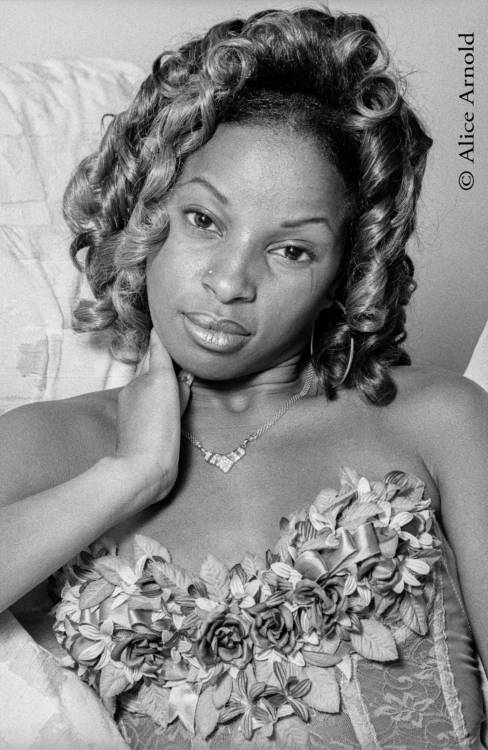
AA: Other than the fact that they didn’t pay you, working with Paper magazine was great. I worked with them steadily from 1993 to 2000, mainly photographing the club and DJ columns, but also portraits and some reportage images of the city. It was a good relationship for me, because I had a lot of creative freedom and it provided access to underground clubs, which were difficult to get into as a photographer.
MG: I remember when you shot Debbie Harry for them.
AA: When I got the call to photograph Debbie Harry, I was surprised and elated. I mean, she is a legend. The shoot took place in my small apartment, which doubled as my studio. She came with her dog for the shoot and he made it into some of the photos. She was lovely to photograph. Most images of her show her as super glamorous, which of course she is, but she showed up wearing ordinary clothes and with a very down-to-earth manner. So this influenced the tenor of the images, which I think have a reflective and soulful quality.
MG: I know you stay busy with teaching and films. Do you still shoot for editorial?
AA: I still photograph projects, but I don’t work for editorial clients or record labels. A lot of my time is taken up with teaching. I’m an adjunct professor and I teach graphic design and doc film production classes. I also work on documentary films (currently working on one about SoHo). I’m very busy with my photo archive. I’m working on a book of club photography and I have some photos of people and places that people are interested in now.
Alice Arnold is a documentary media maker and educator. Her film and photography projects explore the urban environment and visual culture, from street art to advertising and from sidewalks to electric signs. Her films are in the collections of university libraries and have screened at MoMA and other festivals. Her photographs of nightlife, hip hop culture and portraits have been widely exhibited and published in books and magazines. She is a NYFA Photography Fellow (2003), a Fulbright Fellow (Film, Hong Kong, 2007), a Graham Foundation recipient (2025), a NYSCA artist (2026) and an Adjunct Professor at the City University of New York. Learn more: https://a2studio.org