

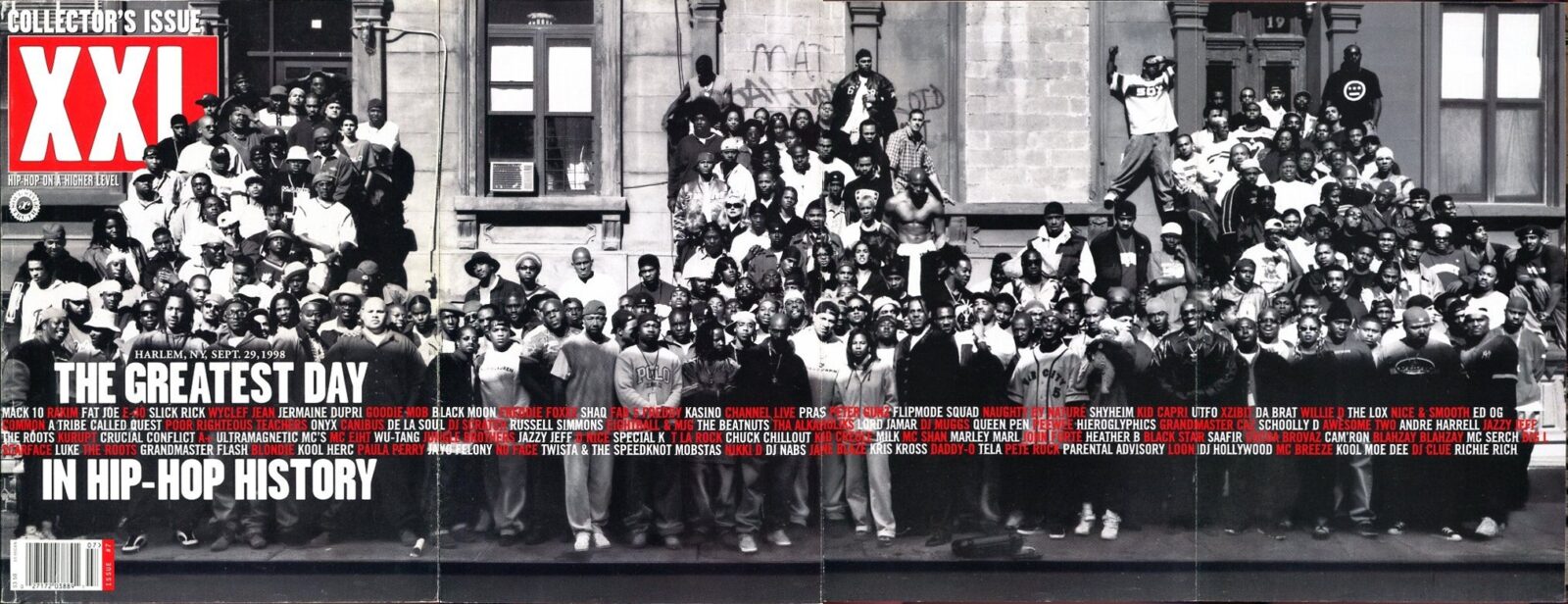
On a spring night in 2014, during the Gordon Parks Foundation’s annual black-tie awards dinner at Cipriani Wall Street, Swizz Beatz—hip hop’s nouveau riche art collector and producer extraordinaire—purchased a photograph for $28,000.
It was by Parks, who recreated “A Great Day in Harlem,” a famed Esquire photo of 1950s jazz players (including Thelonious Monk, Dizzy Gillespie, and Count Basie), this time featuring late-nineties rappers (Q-Tip, Fat Joe, Black Thought, and others) for an XXL magazine cover. The previous year, the legendary photographer had released Half Past Autumn, a career-spanning collection that crystallized his legacy, from his early assignments for Life magazine to images from his 1971 book Born Black, and stills from films he directed, including Shaft and The Learning Tree.
Having lensed icons of jazz like Duke Ellington and Louis Armstrong in the past, Parks seemed the perfect choice for capturing the African American musical form which dominated the 20th century’s last decade. Where jazz was once Black folks’ music of choice, hip hop held that space strong by the ’90s. Back in September 1998, I’d stood near Parks shooting that very photo in Harlem—an idea devised by XXL’s then editor-in-chief, Sheena Lester.
With publishers both major and independent sensing rap music’s eminent takeover of pop culture, hip hop practically glutted the newsstands at that time: ego trip, Rap Sheet, Blaze, 4080, on and on. In the hierarchy of rap magazines circa 1998, The Source laid claim to must-read, “hip hop Bible” status; Vibe boasted photography and journalism on par with rock journals like Rolling Stone; and XXL (founded in ’97) stood as the scrappy, sophisticated upstart. Its covers styled the likes of Jay-Z, Nas, and Biggie Smalls in suits, rare for the time, with New Journalism-comparable writing by the likes of Michael A. Gonzales and this writer. (I served as deputy editor from 1998-1999.) Founding editors abandoned XXL’s publisher early on (citing disagreements over equity with Harris Publications), leading to the installment of Lester—who’d proven her dedication to hip hop culture as the music editor at Vibe and, previously, the editor-in-chief of the Los Angeles-based Rap Pages magazine. At the time, female editors at rap publications could practically be counted on one hand: dream hampton and Kierna Mayo at The Source; Danyel Smith and Michaela Angela Davis at Vibe.
Georgia-born and California-raised, Lester says she “had been a writer since I could pick up a pen.” While studying at Los Angeles Trade-Technical College in the early ’90s, she learned that a close family friend had purchased the Los Angeles Sentinel, a local African American weekly newspaper founded in 1933. Picking up experience in the paper’s proofreading department soon led to editing duties, some freelancing for The Source, and eventually an appointment as head of the nascent Rap Pages magazine, published by porn magnate Larry Flynt.
Presently, Lester lives on the Left Coast where she helped launch Blacktoberfest—a yearly craft beer festival showcasing Black-owned breweries that combines beer, food, art and entertainment. Over two summertime conversations, Lester looked back on her time as one of a scant group of female hip hop magazine editors, covering rap as it elbowed its way into American pop culture once and for all time.
* * *
Miles Marshall Lewis: Tell me about growing up.
Sheena Lester: I was born in Albany, Georgia—the same hometown as my mom and my big sister. Then my mom and my dad moved out to California. He was a Marine. In California they had my brother, and then we moved to Japan for a little while. Iwakuni might be southern Japan, I’m not sure, but there’s a Marine base. We lived there and then came back to California, then moved to San Bernardino when my dad left the corps.
Once we moved to San Bernardino, we integrated into the northern part of the town. Funny, he and his best friend at the time—a white man named Walt Johnson—went walking around for blocks just to introduce him and let folks know he was there. It was fine for a little bit. Then, after a year or two, one of the older brothers of my friends came and burned a cross on our yard. Yeah, that was no fun. I might have been in the sixth grade. I was at my best friend’s house, and her older sister was at my house with my big sister. And my little brother was there too with their little brother. We were all mutual best friends. My mom and dad had gone to the movies, ’cause this happened while the teens were there alone. These guys came to our house and rode their motorcycles onto our front yard and burned a cross on it. That was messed up, of course, and that certainly put a dent in our stay in a big way. But after that, the neighborhood kind of rallied around us. It certainly didn’t stop us from making future friends. I had great high school years. That community is certainly more diverse now.
We lived there for a few more years, and then after high school, my dad’s best friend, Ken Thomas, bought the Los Angeles Sentinel. My dad went to work for him, and I went to L.A. Trade-Tech for a while working in the circulation department. I was staying late to work with the editors; they were editing layout pages. I was staying late helping them do that, waiting for my dad, basically. And then one night the editor asked, why can’t I move back to that section and just help out period. Like, “Hey, she’s a good editor, c’mon.” So I moved back there and started editing. And then came writing. I was at the Sentinel for eight to ten years. It was a while. Then from there, I went to magazines.
MML: What was your path to getting appointed editor-in-chief at Rap Pages magazine?
SL: In the early ’90s I was doing some freelance writing alongside my work at Sentinel. There was a nightclub magazine out here that I was working for called Paradise 24, by the club of that name. It was a promotional magazine that profiled people and businesses for their patrons. I don’t know that it had a particular philosophy. It was just a promotional avenue in print. It loved Black people, Black music, Black culture.
I started doing some freelancing for The Source and cultivating great friendships and relationships there. I was sort of whispering with Source magazine co-founder Dave Mays about a potential West Coast editorship. I think he was talking around me, a little bit, to gauge my interest at the same time that Dane Webb reached out to me about Rap Pages.
Dane had been an editor there, and he introduced me to James Webb, who was the head of Larry Flynt’s bodyguard squad. James had proposed Rap Pages to Larry. Larry was publishing all kinds of magazines: it was just one more to add. He started publishing Rap Pages, with James as the associate publisher. He hired Dane initially, and then Dane introduced me to James so I could do the magazine up for him.
MML: So you were the first editor-in-chief?
SL: No, I think Dane was the first editor-in-chief. Because in the very first issue of Rap Pages, Ice Cube is on the cover. There were a couple of issues with Dane at the helm. Then, I think Dane left to do something else. I took over from him with his introduction to James and his blessing.
MML: What was your first cover?
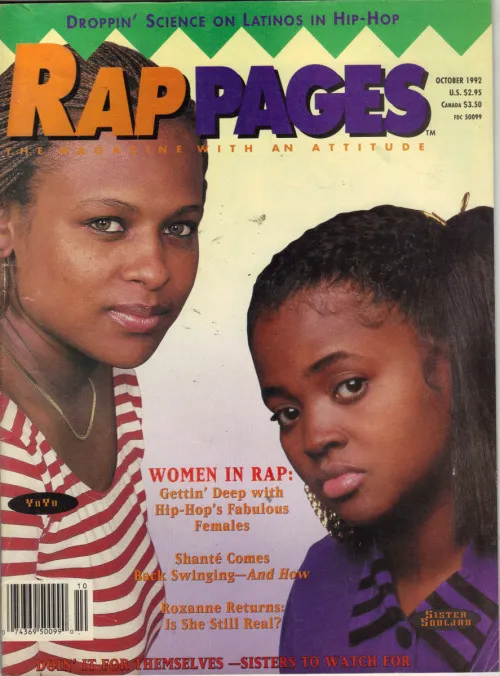
SL: I wanna say it was a women in hip hop issue. It had to be ’92 because it was after the L.A. riots. When I was working at the L.A. Sentinel, I was the editor of the “Young Ideas” page, and I had a little squad of teenage writers for that section of the paper. So we were going to events and I was editing the stuff that they were writing for it. They were wonderful. For this particular issue of Rap Pages, we did a photo shoot where we shot rapper and radio personality the Poetess—who would become my best friend in the world and still is—and some of the girls from my squad in a burned-out building on Adams and Crenshaw. I think they were wearing African American college AACA sweatshirts. I think that was my first issue.
In another early issue, I ran a conversation between myself, Yo-Yo, Sistah Souljah, and the Poetess. On the cover were Yo-Yo and Sister Souljah. God, I hated that cover, hahaha. I hated that font, ugh. But it was early in my magazine days. I was kind of learning, but I know I didn’t like that—whatever it was. I believe that was my first one.
MML: What didn’t you like about that cover, besides the font?
SL: When you look at Rap Pages’ other covers and compare them to that one, there’s a clear difference in the artistry, frankly. I think it just wasn’t as well thought out. I didn’t have any real kind of relationship with the art director at the time. It just represented an early stage of the magazine with me at the helm. I wish that we had done a better crafted artistic representation of that conversation.
MML: How did you find your “little squad of teenage writers”? What did they write about, and what was the idea behind engaging youth in journalism?
SL: There was a section in the L.A. Sentinel called “Young Ideas” and we advertised for writers in the publication. Some squad of girls came up there and I basically mentored them. Took them out for stuff in the community. They wrote about those things, and we just created a section devoted to what they thought was important and should be prioritized. I’m still Facebook friends with some of them. I have a feeling that if they had gone off into journalism in some real way, I would have heard from them about it. I hope so.
MML: Were you already interested in writing when you began at the L.A. Sentinel?
SL: I had been a writer since I could pick up a pen, really. I’d always written something or other. If it wasn’t poetry, it was something expressive. So when my dad’s best friend bought the Sentinel and I started working there in the circulation department, it was just a job for me to have while I was going to L.A. Trade-Tech trying to figure out what I was going to do with my life. But I had always been a writer. When I was staying late to help proofread pages that were going to print, the editor asked that I be transferred back there so I could help do that. So that was when I joined the editorial team in general. Once they discovered I could write, it was a whole other thing.
Writing, to me, has always been about service. That’s what journalism is—or used to be. I don’t know that it is anymore. For me, it’s about using the word as a way to be of service to your community in a real way. The L.A. Sentinel’s history was rooted in resistance, so that’s always been something that’s been a part of my connection to journalism too. Because that’s what I learned and that’s what always attracted me about writing in general. The universe brought everything together like it should have, I guess. I was just super lucky.
MML: What was hip hop coverage like in the mainstream media when rap magazines launched?
SL: Well, ultimately, the only hip hop source that mattered was The Source. Rolling Stone and Spin, they were treating hip hop as an aside. They were serving their reader audience with mostly white pop and alternative music. And so there wasn’t really anything that served the hip hop audience except The Source. And they did it well. Nobody was complaining about The Source. The writing was tight. The editors were dope. There were no ego issues. Back then, it really was about the reader. That’s the one thing I love the most about my time learning journalism at the L.A. Sentinel. Because the Sentinel was founded on the premise of “don’t spend money where you can’t work”—they were rooted in activism—it was always about advocacy journalism. When you love your people and you want to advocate for them, it doesn’t feel like work. So that’s how it was for me. I just loved it seriously. And The Source, to me, was everything that I valued in journalism, both as a journalist and as a consumer.
When Rap Pages came out and hired me, I had already done some freelance work for The Source and already knew most of their staff. And all was well. The shame was that there weren’t really enough fantastic hip hop journalists getting play where they should have at the various other magazines. I loved being able to come to Rap Pages and work with the gamut of brilliant young people passionate about hip hop music, hip hop culture, hip hop people, be they Black, white or candy-striped. That’s what made it special, because ultimately, hip hop journalism was advocacy journalism. And so it all fit in with what I had learned, learned to love, and learned to advocate for.
MML: When you took over Rap Pages in 1992, what other rap publications existed?
SL: Back then, I think it was just The Source. I mean eventually, Rap Sheet started to publish in newsprint. And then Urb, which was a L.A.-based magazine. But that wasn’t strictly hip hop. That was just sort of alternative culture and it was run by a brother who was just into all kinds of fantastic stuff including jungle, EDM, and rave culture: Raymond Roker. And Urb was just fantastically hip hop because the scene was fantastically hip hop. No one would categorize Urb as a hip hop magazine. It was a force because what was going on in culture contained hip hop and other kinds of music and culture that made L.A. the place to be.
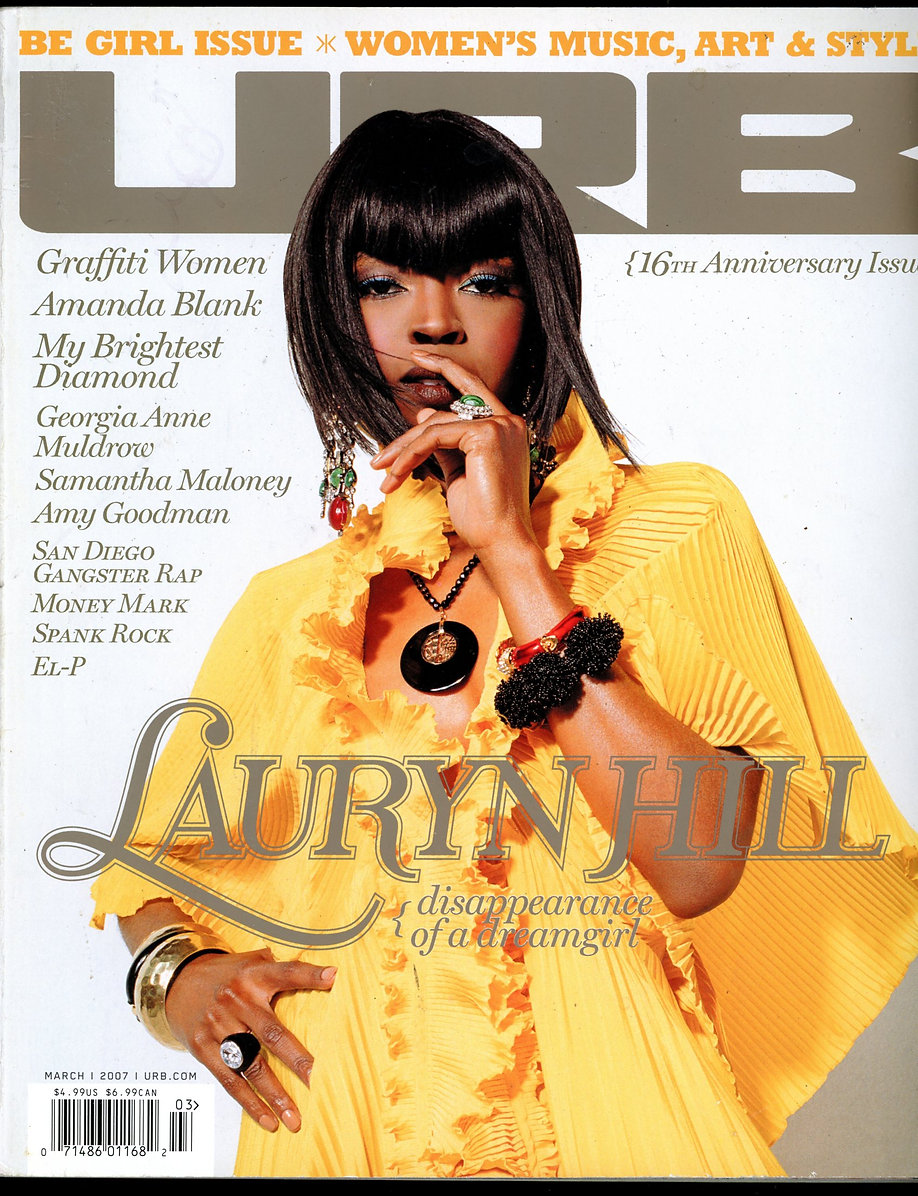
MML: What kinds of “fantastic stuff” did Raymond Roker publish at Urb, and what was the relationship between hip hop and other emergent cultures in L.A.?
SL: Urb was a good local publication. They were more diverse in their coverage than we were. We were covering hip hop; they were covering sort of alternative L.A. via hip hop and white alternative music and culture in a way that we weren’t. They did their thing, they did it well. They had journalists who cared about the clubs and the people they were profiling.
MML: What years are we talking about, and what made L.A. “the place to be” at that time?
SL: Because of the people who were here, the people who were making the music and loving the music, and the people who were the creative foundation for all that was created here. We’re talking about the mid-nineties, basically. We had great hip hop, we had great jazz, we had great dance—great everything that was coming together here and all over the country and the world. We were appreciative of it, not just here, but all over the world. L.A.’s always been special because of its practicality. We understand very clearly how lucky we are to be here because of the way that culture converges in Los Angeles. And you’ve got the ocean a bus ride away, so it’s Christmas every morning.
MML: How did those days feel, living and breathing hip hop culture while reporting on it all-access?
SL: I think the thing about it is, we were just doing what we loved, literally. I didn’t really think much about what I was doing because I was just doing it. I was just working with fantastic writers, meeting deadlines and planning issues and doing photo shoots with fantastic art folk. I didn’t even think about it because we were too busy serving the reader. Ultimately that’s what all good journalism was and should be now. You just gotta be in love with the reader. You can keep it very ego-free when you’re not thinking of yourself. And that’s always how it was. You could play yourself being on some ego nonsense, particularly if you’re not one of the artists granting access. How do you look having ego when you can have the access you have snatched from you? We were dealing with a vantage of folk who were ego-free. Everybody was just hungry and loving the work and loving the music. That’s really all it was. Ultimately serving the people who we hoped were picking up our publication, the diehard hip hop heads that we knew were picking up our publication. We just wanted to love up on them as much as we could, and it felt good to do it. So that’s really what I thought about it. I just thought about making our deadlines and making sure everything was crispy and clean, and it was. Again, for me it was just about being surrounded by fantastic folk.
MML: Who did you envision as the reader of the Sentinel, Rap Pages, and XXL?
SL: For Sentinel, we’re talking about Los Angeles Black people. For Rap Pages, we’re talking about lovers of hip hop culture within the magazine’s reaching distance, and same with XXL. With XXL, it was just about being a part of a group of magazines serving a very specific readership. A very specific kind of journalism. With XXL at the time, we were trying to make something that was… I don’t know if it was a particular, smart kind of men’s magazine. I know we were doing dual covers in a way that was about showing the different sides of not just folks who had things to offer that particular month, but we were trying to leave our readers with something other than the obvious. That’s always been how I’ve felt about writing. As an editor, I always felt lucky to amass writing that I could work with and do it consistently with the kind of passion that I did.
MML: What was it like to be a woman working in hip hop culture? How did you understand your role?
SL: I considered my role more so as a Black journalist. As women, we do what we have to do, period. And hopefully we look out for our own wherever we can, which is something that I certainly did. Just as good karma. Always look out for the other sisters looking to come up and to be that spot in the ladder for them. I always felt like it was a privilege to lead the teams that I did. I don’t think I had any real role as a woman other than to represent the best that I could as a woman in journalism. To just sort of be the best that I could be, make it go from there.
MML: How did you make the transition from Rap Pages to XXL?
SL: It was just a new job, it wasn’t that deep. I had kids to feed, bills to pay. I moved from L.A. to New York. I was in New York, New Jersey, Philly. It wasn’t any super transition. I was dealing with the same type of work. The same group of writers who were wherever I was. Luckily, I was able to bring people with me in certain ways and had the privilege of meeting new people that made the trips engaging and worthwhile at the various publications. But I never really felt any dramatic transition. It was just work that we gotta get done. One thing Black women know how to do is the job when they gotta get it done.
MML: Did running Rap Pages, and later XXL, offend any feminist sensibilities you may have had?
SL: I didn’t have a single issue with it, I guess because I was editor-in- chief. But I also was putting women on, left and right. It wasn’t even a thing to me. There were too many talented women around to not have them writing for us or taking pictures or whatever. It was always just about using the folk who were passionate and excited, flexible and who we could afford and loved working with. And that just happened to be a fantastic group of women. We discussed sexism in the magazine. I ran a conversation about women in hip hop. Yo-Yo, the Poetess, and Sister Souljah had great things to say as artists and as fans. We just always had women in our issues. For us it was just: women are a part of the culture, so of course they’re gonna be a part of our coverage.
MML: How have you seen or experienced misogyny in that culture?
SL: Misogyny means what, the hatred of women? I think that sort of speaks for itself. There’s a lot of hatred of women in hip hop. But I really don’t care about it, frankly, because a lot of these fools who were making bad hip hop, I’m just ignoring. The one thing that the pandemic gave me was a whole new set of rules. I’m pretty militant about the stuff I actively don’t give a damn about anymore. And I’m really good at ignoring people who are not doing anything worth my attention. Saying it, doing it, creating it—I’m really good at actively ignoring stuff like that. I’ve always been really good at that. This pandemic really sealed it for real.
MML: Would you consider the Gordon Parks XXL cover to be your crowning achievement in hip hop media?
SL: I think that is probably my crowning journalistic achievement period. I’ve done a lot of work I am proud of, but seeing that photo from floor to sky at the Contact High exhibit at the International Center of Photography was really something else. It was literally larger than life in a way that was just fantastic. Something about that day set in my spirit since it happened. Only because of the energy of that day. It was an unexpected lovefest, it was so much love, everywhere, I’m still high on it honestly. And the fact that I had the honor of getting Gordon Parks to do it… My only regret is that I didn’t meet him that day. I was so busy out there, plus I had one of my twins on my back. I was both the mama and the manager. I just didn’t think about taking the time to go over and meet him. I don’t know why I didn’t think about that. Anytime he wasn’t in front of that camera getting shots, he was talking to those gentlemen in suits, he was surrounded by them. So, yeah, it was a big fat lovefest.
Actually, the only real negative situation I’ve ever been in professionally with a woman was when I left Vibe magazine to go to XXL and we shot “Great Day In Hip Hop.” The then-editor-in-chief of Vibe magazine subsequently tried to ban artists from appearing in Vibe if they came to “Great Day In Hip Hop.” Which was stunning. Because the idea that she was trying to stop other famous, brilliant Black folks from being captured for posterity by Gordon Parks was just the most sexist thing I could ever imagine. I was so furious. It wasn’t just us she did it to. Again, Black women don’t do this to each other. Not Black women who care about each other, who value each other. That messed with me for a long time.
But again, there was so much to be high on from that day as a result of all my other fantastic interactions with the folks who did the shoot with me. Lesley Pitts, Biff Warren, everybody else who made my career wonderful.
MML: Explain the appeal of magazines to those who grew up on blogs, podcasts and social media.
SL: The appeal of magazines was just the experience of anticipation, the arrival. The glory of a cover presented in a way that you weren’t expecting—just flipped your wig in whatever way for whatever reason. An experience of the layout. Flipping through pages. Just the interweaving of advertising and editorial. Beautiful photography meshed with beautiful fonts, the layouts of dynamic, resonant, meaningful commentary. Interviews, or just explanation. Oh, I miss magazines so much. Only because the ones that exist now don’t give me the same kind of experience because of the way that the internet has changed everything. I would have to take them to a newsstand and really take them through the racks and show them the difference. I don’t know whether or not people would let you finger magazines now. But I would have them see the experience and feel it, and they would see the difference. There’s a difference in the way that stories are told now. The stories that you see on your phone or on a website, they’re not as long. They’re not thinking about the reader the way that we did. And it’s too bad, because the readers now need it more than we did, frankly. We’re dealing with an age of unabashed American ignorance, and today’s journalism doesn’t make it any better.
MML: Watching Kevin Hart interview Jay-Z for Hart to Heart or Rick Rubin interview Paul McCartney on McCartney 3, 2, 1 or N.O.R.E. host Drink Champs shows how much music journalism has changed.
SL: You know what I think has happened? I think that we have messed around and made journalism look easy and unimportant. And ego-ridden. The fact that journalism today is rooted in egocentricity has murdered the game for me. Because again, you’re not thinking about the reader, you’re thinking about yourself. And you’re thinking about how many clicks you can get or how many followers you’re gonna gain. All that is foreign to me. I’m not the least bit interested in that. I just wanna know what the person who’s reading what we’ve created—what they feel, what they experience, what they know, how they’ve improved. And I don’t think that journalism today is rooted in that. So it’s not journalism. You may as well be what they call the advertorial, the advertising where the layouts were paid for.
You’ve got to root out the ones who absolutely care about the observer. It’s more the exception than the rule and it’s sad and sickening. Aside from the fact that a lot of these kids ain’t doing the basics: who, what, where, when, why, how, what time journalism. It’s something else. That’s probably why I’m diving off into Black beer with such a passion, because again, it’s a passion.
MML: Do you think mainstream media caught up to what we were doing? Cardi B on the cover of Vogue and Lizzo on the cover of Elle would never have happened in the ’90s.
SL: Well, in all fairness, I have not been completely in touch with what mainstream media has been up to because I’ve been caring for a father who has Parkinson’s disease and plotting these beer festivals and trying to love up on the people I really care for in ways that resonate beyond the media. And I feel like every time I turn on the media or see something, I just feel disappointed. So I’m looking for fewer of those moments. I see these images, particularly the ones of Cardi B and Lizzo, and I’m thrilled because they’re beautiful Black women living their dreams. And ultimately, that’s all they need to be, for any of us. I don’t know how those mainstream media outlets are exploring them. I have no idea. But I love seeing them. And I wanna see more of them everywhere I look. I just wanna make sure that we as consumers value what we’re buying and that we are wise in who we look to for our media nowadays.
Because misinformation is as rampant as facts. And so is exploitation. I love seeing any Black woman living her dreams and being celebrated for it in any way. But I don’t know that mainstream media values us, I really don’t. Because that’s not what mainstream society tells me. There might be a little more icing than cake. But I guess it’s still delicious.
MML: What’s the difference between selflessly prioritizing the reader as reader and capitalistically prioritizing the reader as consumer?
SL: It’s not that deep. Ultimately, you want the reader to consume what you produce for them. And you wanna leave them with something that satisfies them. It’s like you’re ordering food. You know what you wanna eat, you get it, hopefully it tastes good, it goes down, you enjoy it, you’re full. It’s the same concept, basically. I’ve always wanted to serve the reader something that I knew would engage them in a way that was meaningful. Particularly Black folks because we have a lot to explore and celebrate. That’s what it always has been for me. Everything else has always been a bonus.
My problem is that I don’t know that people care about the audience in a real way anymore. It’s just about that click, whatever that feels like. I’m very analog, versus digital. Particularly in publishing. I don’t know the SEO metrics or any of it. But I know when someone’s giving me some trivial nonsense. I certainly knew enough about plagiarism to know that somebody has copied somewhere else or lifted and rewritten from the website. That just reads as lazy to me. I certainly recognize lazy journalism. If you’re looking for a consumer to desire what you’ve created for them, you’ve gotta make it worth their while in a real way. And I don’t know if journalism does that anymore. I’m looking at journalism that I know is lazy. And I feel our country and our people are ultimately suffering for it. We’re getting dumber by the day. And as long as somebody’s making money, that doesn’t seem to be a problem. And that’s really, really nauseating.
MML: What would you charge the next generation of bold women storming the gates of media?
SL: Ooo darling, that is easy. More introspection. More bravery and boldness while being and thinking from a selfless standpoint. Journalism is absolutely rooted in selflessness. You have to be thinking about everything but yourself. Just what’s in your brain and what you can tell the person you’re trying to serve this stuff to. Not thinking from the ego makes it super easy. You’re just trying to love up on the next man. And everybody has the capacity to do that more than they can even imagine.
What I would tell these girls is to know your power, but to know it so much that you don’t need to be reminded of it via ego moments. Please don’t let ego be the reason that you fail yourself or your people. Don’t do that. And unfortunately, social media is feeding that fuel in a way that’s not good for sisters that really care about journalism, facts, context, or our future. More love for yourself, mirrored by love for your people. Everything else is a bonus.