


It’s the early ’90s. I’m sitting in front of the wood grain boxed Magnavox watching Tina Turner chant Nam-myoho-renge-kyo, Nam-myoho-renge-kyo, Nam-myoho-renge-kyo. Or rather: Angela Bassett as Tina Turner. Her face is wet with tears; behind her the room moves in candlelight, warm teal and deep purple waves.
Her former backup singer and friend Jackie (played by Vanessa Bell Calloway) is teaching her this Buddhist chant because Tina has just been reaching out—very literally—for something that can disrupt her life’s pattern: suffering Ike’s abuse and returning to him over and over again.
In this moment, Tina has the gift of desperation. She’ll try anything.
“It’s chanting . . . and when you chant, Anna,” says Jackie in the film—calling Tina by her birth name, calling to the real person she sees deep inside—“you can see things clearly. It’s like life’s mirror. When you can see yourself clearly, you can change anything.” The prayer candles flicker, and Jackie loops the mala beads around her fingers, like a cat’s cradle waiting for a friend’s hand. They begin to chant together.
When I first watch this scene, I am in elementary school—a long way away from my own moment of desperation. I won’t live in a house with alcohol until I move in with my father several years later, but the two adults in my first home fight religiously and chain smoke cigarettes. My grandfather offers me one when I’m eight years old, before or after he kicks my mother in the shin and she knocks him upside the head with the heavy, black rotary phone. I hide in our shared bedroom and rub my hands along the grass cloth wallpaper until it stops.
* * *
None of the adults around me know anything about the Lotus Sutra or Buddhist chanting, but my grandfather, a steel guitar player, sings me to sleep nightly with hymns. Later, when I join my father’s household and he discovers that I like to sing, my stepmother carries me to choir rehearsal, where I find my place in the alto section.
We sing the same verses repeatedly, starting from the top again until we get it right. On Sundays, we stand to sing the chorus just one more time when the congregation erupts into loud weeping and wailing. Each subsequent iteration of our harmonies transforms the air until something begins to move through us: a sister in the Nurses Guild section screams, then two more near her are hit with convulsions. The ushers move to protect people from themselves and the wave travels across the aisle to my father, who stands and hollers—climbing the pews and stepping across their backs like rocks across a creek, towards the back of the church, sweating out Saturday night’s tequila. It’s the Spirit I’m watching move, in our sound, through the bodies of the believers.
This is my favorite time of the week. I think it’s religious devotion that has ahold of me, but really, it’s this sanctioned opportunity to open myself up to be entered by another—another feeling, another substance, another spirit. This being the only way to escape the body while in the body. This body—the teen girl body and its compressed world, begging: encore, encore, more more more, wanting to be possessed by the Spirit right now right now.
* * *
It’s 2009. I’m sitting on a bench with bell hooks, outside a university ballroom where she has just given a talk. She tells me: “I am a Buddhist-Christian.” A thing I didn’t know one could be. A thing I start to think about being.
I have forgotten about Tina Turner chanting, but I borrow a Buddhist book from the library on campus and sublimate my anger into its pages.
* * *
Here is my ritual: read until the words start to dance. Then, listen to songs on repeat and drink late into the night.
In her song “Krishna Krishna,” Alice Coltrane chants the Hindu deity’s name for five minutes straight. Perfect. I don’t know much of anything about her at this point—about her turn to Eastern spirituality and the practices of meditation and chanting, about her role in her husband John Coltrane’s spiritual awakening after a heroin overdose, or about the chronicling of that awakening in A Love Supreme—widely considered one of the greatest albums of all time.
But it’s her “Turiya & Ramakrishna” that plays endlessly from my one-room apartment in an antebellum house in Lexington, Kentucky. Tunnels sprouting from the structure’s basement run downtown and around the perimeter of the courthouse, where at one time the largest slave market in the central United States buzzed. The house is haunted by men too drunk to maintain housing. They sleep and shit in its hallways. They don’t mind listening to the same song all night, the same words. “Spiritual Eternal” and dark wine. “Journey in Satchidananda” and cheap bourbon. From the top. Glass to my lips. Pull of my cigarette. Glass to my lips. Pull of my cigarette. From the top. Glass to my lips. Until my consciousness goes black and my body continues on animated by other spirits.
This solitary ritual will persist for another 11 years.
* * *
In Houston, my ritual changes. It happens like this:
after ten months of not drinking I come-to behind the wheel at
four in the morning
after hours of blackout [|||||||||||||||||||||||||||||||||||||||||||||||] after saying I won’t drink again. The EMS rushes me to the hospital
in a hypertensive
crisis
this time I reach out for
help
this time I have the gift of
desperation
* * *
Houston is a city of loops, wrapped by two major expressways:
- 1. Sam Houston Pkwy: an 88-mile lasso enclosing the gargantuan metropolis and its extraterritorial jurisdictions, South Park and Pasadena, Aldine and Bellaire; known colloquially as “The Beltway”; memorialized in a song by the same name on Solange’s When I Get Home.
- 2. I-610: a 38-mile belt around the belly of H-Town and its inner-city neighborhoods, River Oaks and Montrose, The Heights and Third Ward; known colloquially as “The Loop,” such that when people live in one of these neighborhoods, they say, “I live inside The Loop.”
For the three years that I live in Houston, I live inside The Loop.
My soundtrack: When I Get Home.
* * *
Listening to When I Get Home (2019), Solange, 39:01, Saint Records
and thinking about chopped music, that Houston-invented genre of sound;
about how it recycles;
about Black people & the recursive mode;
about looping back as a ritual against forgetting;
about the apprehension to exit an intense feeling;
about the effect of it being what we talk about when we say sublime;
about how it’s like chewing;
about how you can’t have spiritual without ritual;
about repetition as a refusal to be bullied by market time;
about Suzanne Césaire’s plant-human, who “abandons (her)self to the rhythm of universal life”;
about the roller rink;
about double dutch;
about practice—keeping at it, staying with it;
about starting again from the top;
about mantras & affirmations;
about Solange saying at her album release party: “Repetition is a really strong way to reinforce these mantras. . . The first four times I didn’t actually believe it, but by the eighth time, it’s coming into my body and my spirit”;
about recursive symphonies of space cowboy synths;
about meditative chant as childhood arcade samples, as snare backbeats, as surreal ethereal falsetto dream-streams;
about Black rodeo as ceremony;
about soulful bayou electronica, Black alien spirituality, ancient ancestral horizon note hummi
opening anterior dimensions with different laws of space, time, and sound;
about Black people & word redundancy, such as kale greens & for real, for real? & I’m done done to indicate a more intense degree of the thing;
about Edouard Glissant saying, “This excess is repetition that signifies”;
about the men in old schools who ciphered our block & the bass moving through the bodies of the believers;
about spinning the block;
about coming back around, as in “yeah, he done started coming back around again”;
about obsession and etching a groove;
about Harriet Jacobs and her loophole of retreat;
about the gerund form;
about the vinyl turning;
about James Snead & “the cut,” the mechanism of the chop, “abruptly skipping it back to another beginning which we’ve already heard,” so that “the thing (the ritual, the dance, the beat) is there for you to pick it up when you come back to it”: —
When I Get Home on repeat, I leave & come back to it. I come back to myself. I come back to get myself. To pick myself up. I come back to the beginning. I’m cuh-coming down. To the child I was before. Before I left myself. I can see myself clearly.
* * *
Solange is not just singing on these records: she’s creating the sound, she’s producing the spiritual infrastructure. Solange as producer joins a sphere of Black women I’ve encountered—each equidistant from me at the center—who have turned to recursive sound to precipitate a personal, spiritual revolution.
Revolution as a method of sound.
Relevant here in all of its denotations—
a forcible overthrow in favor of a new system;
a fundamental and complete change;
an instance of revolving;
an object’s elliptical course
around another object—
the technology Solange creates is a composite of these. It is sound coming back around, being absorbed by the body, as Solange recalls, until the spirit has undergone a complete change in favor of a new self.
To revolutionize. That reflexive transitive
mode inside which one caresses the grassy walls of her prison,
realizes no one is coming
to save her & she must save herself,
inside which she finds that loophole. Through her music,
Solange revolutionizes her way of being in the world. Turning herself into.
Estranged from the choir, this music itself is a technology, we can pick up too, like a double-dutch beat.
Here, repetition is not stasis, it’s on the way somewhere. I listen to the same song on a loop when I write, waiting for the change, the volta, believing something will happen, letting the words happen, over & over until I can see things clearly, until I can re-enter myself anew.
* * *
I enter Houston truly
I enter a different loop
I enter sobriety
I enter a new song
Solange on repeat
Almeda on Almeda
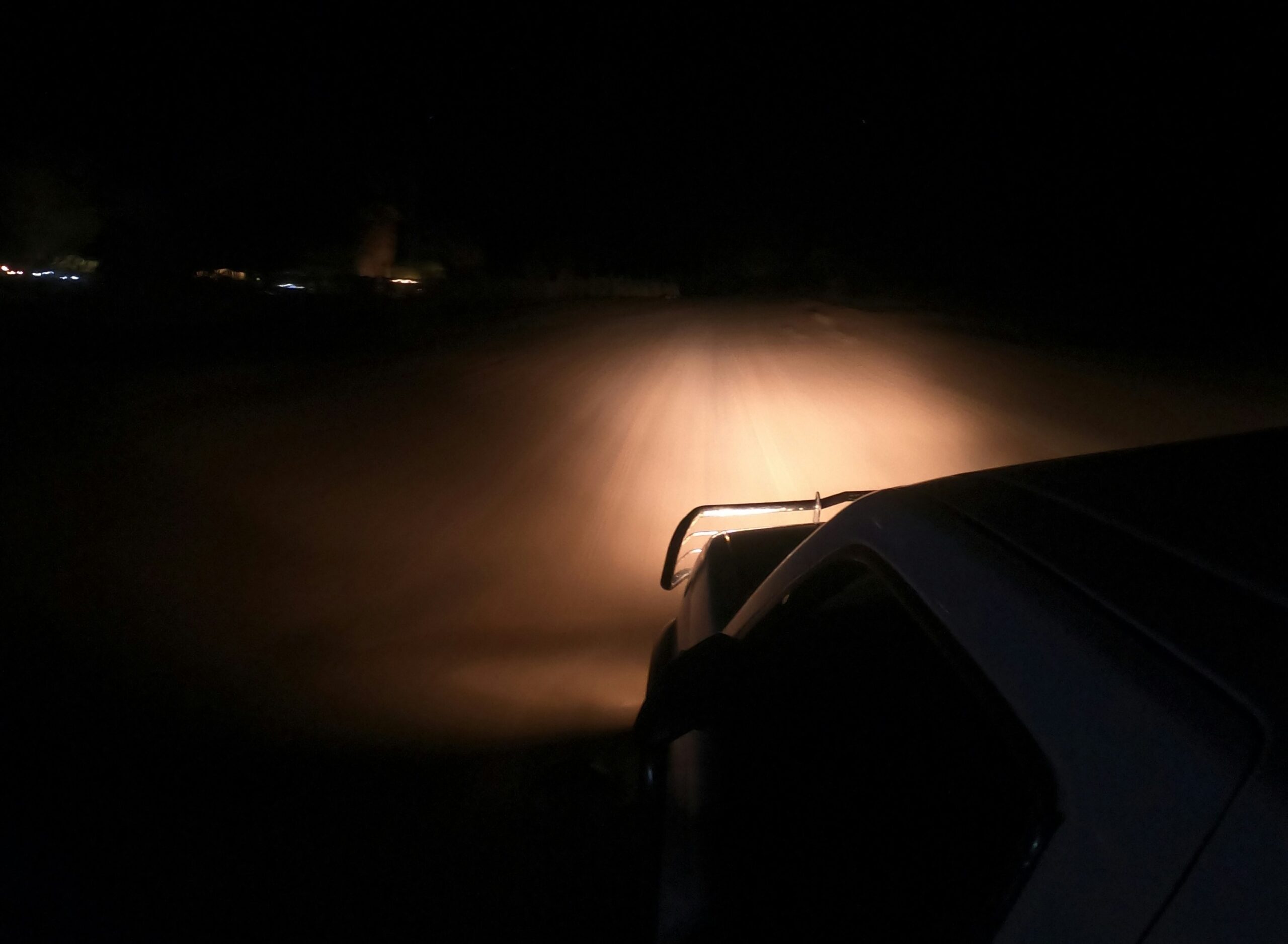
The Beltway riding
The Beltway Wide
Highway oversized
Pickup trucks float
And swerve slowly
Wavy light mirages
In the heat Ignoring
Lane markers Tractor
Trailer horns and
Dusty pavement
Around and around
Loophole of retreat
Nightbugs sparkle
In messy brush at
The edge of the world
Don’t don’t, don’t
They chant Sailing
Through the night
Beneath the highways
Light poles Chiming
Piano Solange chants
Lone Lone, lone I am
Lone Just myself inside
This Loop You love me
Love me love me love
Me Alone inside
My truck Watching
The skyline come
Down Its nighttime
Spaceship light
You love me
Love
me love me
like by saying it enough, the “You” will begin to believe it. I arrive home midwinter and lie under my open window so the spirits can enter. I chant these words against a deeply engrained belief that I’m unloveable so that I can see myself clearly. I chant them against that lonely groove etched into my neuropathways. I chant them until the soundscape’s vintage computer beeps take me away, flying down the psychic Beltway into my future. Inside the loop there’s a turn up ahead.
Source quoted:
Brydon, Grant. “Nothing Without Intention: Solange on the creative process behind ‘When I Get Home’,” Medium, 2 June 2019, https://medium.com/@GrantBrydon/nothing-without-intention-solange-on-the-creative-process-behind-when-i-get-home-4133c3c97be2