


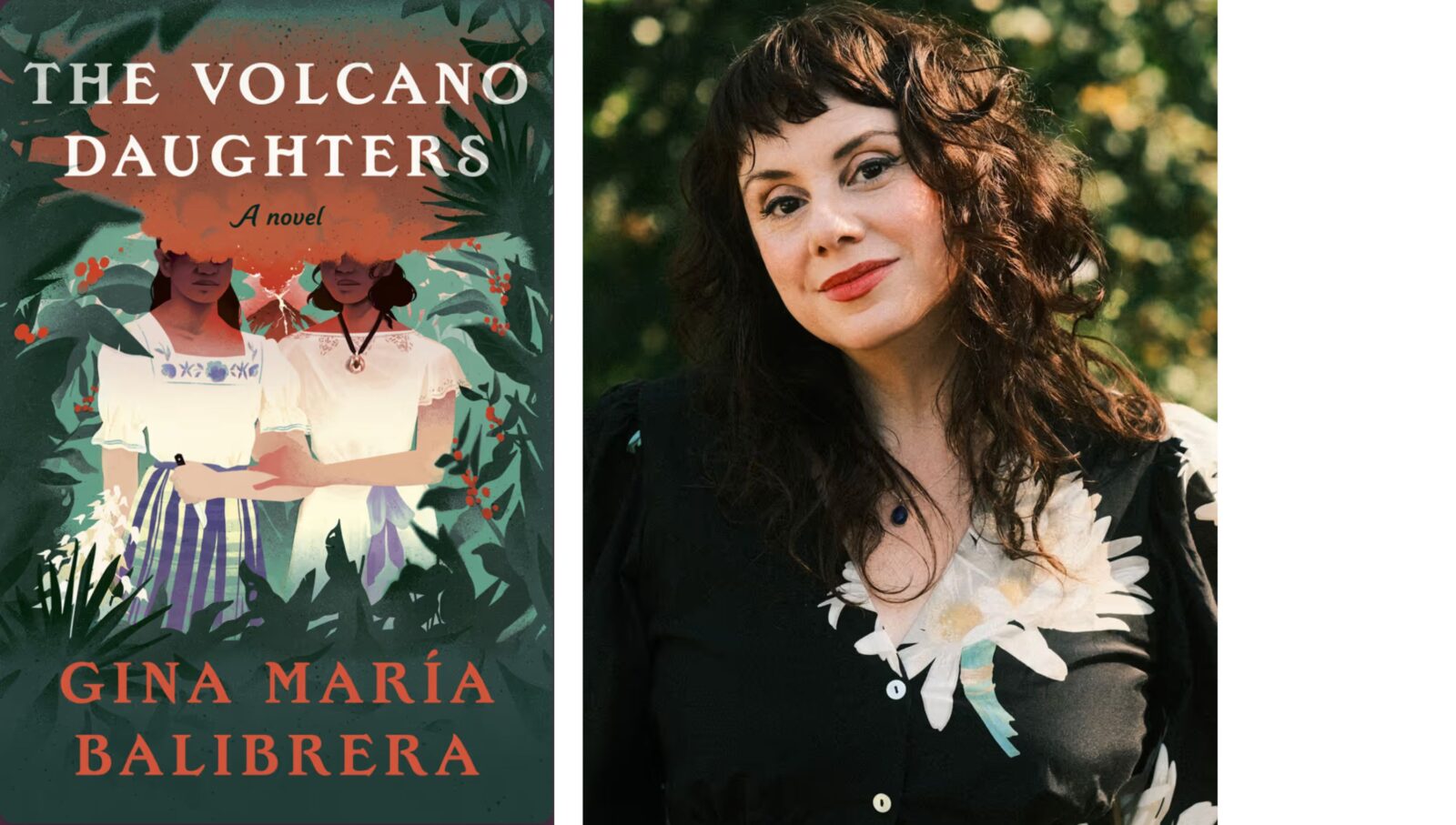
Debut novelist Gina María Balibrera, defines an “imagined history” as a “space where historical characters, false documents, and forgotten stories collide with fiction, to seed, inspire, open, and question the authority of the facts as they have already been written.” Her innovative and expansive historical novel, The Volcano Daughters, creates one such space, informed by research but not confined by it, particularly where the archival record is limited.
The book is narrated by the ghosts of four young women killed in a 1932 genocidal massacre in rural El Salvador. As Lourdes, María, Cora, and Lucía seek to make sense of what happened to them, their voices are heard and transcribed by La Yinita, a writer described in the opening character list as “mestiza, bien educada, un poco nervous, yo.” The ghosts meanwhile live on vicariously through their surviving friends, estranged sisters Graciela and Consuelo, who escape to the U.S. and France to live divergent and fascinating lives of their own, albeit haunted by the deaths of their friends.
I first met Gina as a participant in her online Tin House craft intensive on “Imagined Histories” last summer, and I had the good fortune to meet her again in person at the 2024 Tin House Autumn Workshop. In the following conversation conducted via GoogleDocs, we discuss her inspirations, craft choices, and process.
Jules Fitz Gerald (JFG): In keeping with your definition of “imagined histories” (as mentioned above), what did you find missing from what’s already been written that inspired you to write the story of The Volcano Daughters?
Gina María Balibrera (GMB): So much of what I encountered in the archives is actually really interesting and strangely intimate, if incomplete: befuddled midcentury white men puzzling over extraordinary events, arguing about communism and writing anthropology in strikingly personal voices; the sour-tongued, tropey remove of visitors like the desultory Joan Didion; the mildewed pages I found in San Salvador’s national library so many years ago, full of inscrutable data crumbling in my hands; conflicting accounts, wildly varying numbers of dead and sequences of events and theories of motivation and policy. And I should also say that there’s so much brilliant writing from contemporary scholars that delves into the contours of cultural erasure and into the gaps in the historical records.
When we step back from this particular history and think about how art history is written, the elisions of female genius are apparent—as in the cases of the historic and fictional characters of Consuelo, artists are muses and girlfriends, and their work is stolen or forgotten.
Both versions of lacunae present an invitation to do what fiction writers are already tasked with: to imagine an unknowable interior. From there the story grows.
And this desire lives beside the historical research—I also really longed for ambitious, contemporary, playful literary fiction about this place from a Salvadoran-American perspective. Which certainly exists, but unfortunately, had not been embraced by Big Five publishing when I was writing this book. What a joy now to have two books by Ruben Reyes Jr.—a short story collection and novel—out in the world in the last year. There are so many more of us who have been writing, but are considered still emerging in mainstream literary spaces.
JFG: The book references the Popol Vuh through an epigraph as well as in the acknowledgements; this made me curious to learn more about the text, which I understand now to be a collection of Mayan creation myths and other legends. In reading the introduction to the Michael Bazzett translation, I learned that the versions we have today reference an original manuscript by an unknown author that has since been lost, and as a result, Bazzett says, “we are thus left with the copy of an echo. An echo of a ‘lost book’ that the authors themselves refer to as ilb’al, an instrument of sight.” How did the Popol Vuh shape your thinking about the book?
GMB: The Popol Vuh is astonishing, and I wish I had read it in elementary school when I was reading all of those Greek and Norse mythology books. I didn’t encounter it until relatively late in my writing process, and it was a revelation. Here are the roots of so many contemporary myths and understandings pertaining to motherhood, trickery, disobedience, and creativity. I was amazed by the way time is structured in the myth—how the clock resets, and how the narrative enters an “Eternal Now,” and this timeline emboldened my own choices and the latitude of the ghostly narrators to speak when and where they desired. And the idea of the book itself being a woven mat of narrative, lost and carried forward by speech, really resonated with the multiplicity of voices informing and altering the novel.
JFG: Your approach to the first person collective is fascinating to me; I’ve never read anything quite like it. At what point in your process did the character of La Yinita/Yina emerge as a narrator in addition to the four ghosts, and why did it feel important to include this meta narrative layer?
GMB: I am no god-voice. As a Salvadoran-American who grew up speaking English in California in the 1990s, there’s so much I didn’t already know about this history, this time, this place. And the story itself, as it lives in cultural memory, is contested and unwieldy already. I had no interest in creating another master narrative—Yina’s is a diasporic voice. To write the book I had to be an ardent, humble student, and to collaborate with the ghosts—that’s a gift that fiction permits. To continue in that theme of the book of the woven mat, the ghosts circled around all my gaps in the weaving and prompted the questions that I had to investigate and mull over and write into. The collective ghost voice came first—the story is primarily theirs—and Yina followed later, trying to understand.
JFG: It’s clear you did an incredible amount of research for this book, and during the craft intensive, you told the story of finding “the face in the ruins,” a chiseled stone face, on a research trip to France and how that discovery led you to imagine the character of Consuelo carving it as a portrait of her sister Graciela. Could you talk more about how your research process interacted with your writing process?
GMB: Thank you for remembering that story, Jules. That face in the ruins was such a gift, and I didn’t know how to make sense of it for a long time. It sat like a puzzle in my mind for a few years as I worried that I had made the book too big and as I got to know the characters more. Researching the many worlds of this book was sometimes too compelling for my story-hungry brain—I had to detach and do the harder work of animating these characters with their own particular fictional lives. Often a beautiful detail or image or historical footnote functioned as a prompt that led me entirely elsewhere, and then I’d go back and erase it.
JFG: While this is in many ways a book about grief in response to atrocity, there is also a lot of playfulness and joy, especially in the behavior of the ghosts. I also noticed that one of the Spanish words that appears most often in the book is carcajadas, referring to a cackle or laughter. Could you talk more about how you came to this way of envisioning these characters in the afterlife?
GMB: I didn’t want these women, murdered as teenagers, to be characterized as saintly martyrs stripped of all rage, joy, and youthful insolence. I wanted them to live in these pages, and I found both defiance and precise powers of observation in their laughter.
JFG: If you could travel back in time to talk to your younger self as you were starting out writing this novel (in 2011, right?), what words of advice would you share? Or, how would you encourage other writers embarking on the writing of historical novels of a similarly ambitious scope and/or who are imagining their way into archival silences?
GMB: I have the sense that each book is its own wild animal, and having completed only one of these, I feel that I’m a poor expert. But we have to buoy ourselves and the writers in our communities who are taking on work like this—encouragement is vital. I don’t think that there are shortcuts, but a willingness to be a voracious student with a beginner’s mind absolutely helps. Pocket the tiny details that magnetize you and be patient as you transform them, making them your own. Enjoy the research, but don’t become transfixed or beholden to it—continue writing your own story throughout. Try to find delight as you slog through draft after draft. And I believe that placing yourself in a writing community—sharing your work with trusted readers and reading other people’s work with attention and the desire to help them to realize their vision—makes the ambitious, unfinished thing real and alive, even if it’s not yet fully-formed.
The Volcano Daughters is now available in paperback from Penguin Random House (Pub: July 8, 2025).