

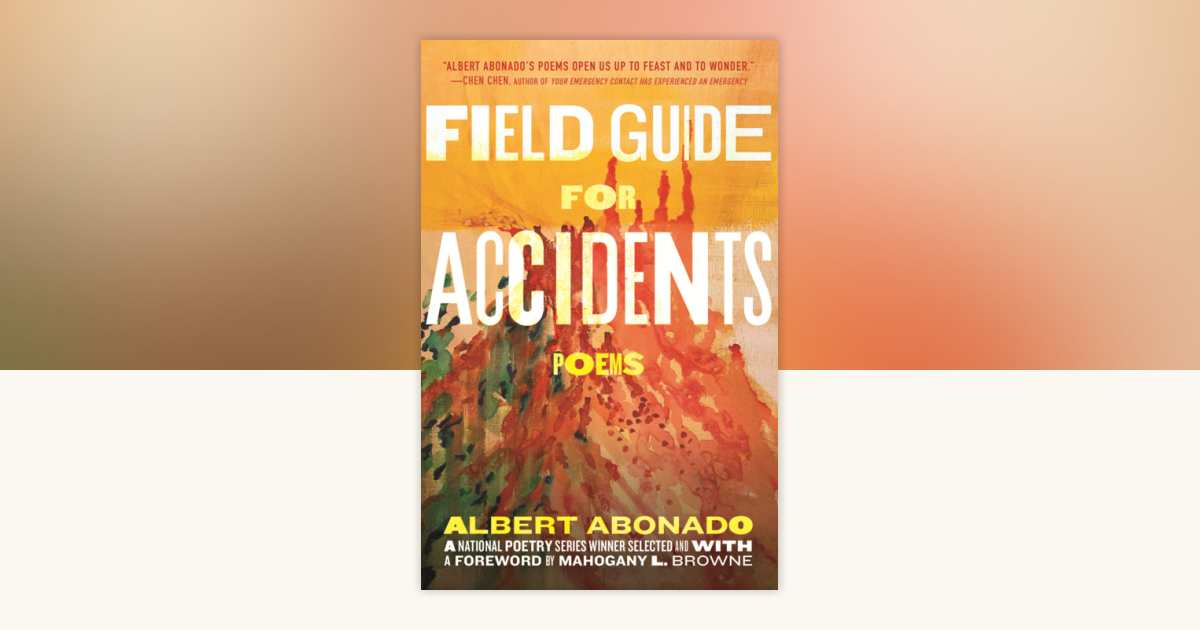
To open Albert Abonado’s latest poetry collection is to be greeted with a feast of flavors: ginger and garlic. Bitter melon. Bay leaf, vinegar, a steaming plate of rice. In these poems, food is more than physical sustenance—it is a language of memory and resistance, passed down through generations.
Field Guide for Accidents invites readers to take a seat at a table where family stories, prayers, and silences are spun into daring, intimate poems. With fresh clarity, Abonado confronts the complexities of the body, identity, and the personal and political forces that shape them. His words teem with life, indulging in its sights and smells. At once voracious and edible, poems, for Abonado, “chew / on your cuticles” with a “mouth full of heirlooms”; they are tasted, swallowed, left to “nest in the guts.”
Reading these poems, some of my own memories resurface and sharpen. One, in particular, stands out: I think of my mother sitting beside me, clipping and filing my fingernails, even though I was, by then, old enough to do it myself. The adolescent part of me, itching for independence, wanted to resist her touch, to pull my hands away from hers. But together, we yielded to this ritual—one we had shared all my life. It occurs to me now how lucky I am to carry that gesture of care with me, forever and wherever I go. These ordinary habits reveal a contradictory truth woven through Abonado’s collection: no matter the distance that grows between us and our kin, the warmth of certain customs and memories keeps us inextricable.
In poems like “Mano,” Abonado elevates such small, seemingly mundane actions to sacred practices: “If I perform a gesture enough / times, it turns into a holy reflex,” he writes of the unspoken acts that bind us to each other and to ourselves. Abonado attends to the body through an accretion of tactile details—wrists, fingers, heat, a bee sting, a stroke—and a porousness that allows past, present, and future to live on a single page. Here, the body becomes an insistent site of inquiry—treated not just as a manifestation of love but its very method. Love is pulling white hairs from a father’s scalp; it is washing and moisturizing one’s face. It is a lover’s lips on the nape of the neck, or a home-cooked meal scooped up by one’s fingers, enabling the body to keep moving and breathing.
Such tender attendance to oneself and loved ones feels radical in a society where care is withheld or given in unequal measures. Field Guide is conscious of the larger forces that neglect the body on a systemic level. As a first-generation son of Filipino immigrants, Abonado confronts how certain bodies are exploited in America—their needs ignored, and their right to rest and safety denied. The poems’ fixation on the body seems, in part, like a response to these injustices: a witnessing and devotion to the body that has been overworked and undervalued. In the title poem, Abonado scrutinizes the crisis of sleep deprivation and its psychological and physical tolls, particularly on marginalized groups. “White people sleep better and longer in America,” he writes, pointing to the accumulation of inequalities that make people of color more vulnerable to fatigue, violence, and erasure.
At the heart of the collection lies Abonado’s personal and familial history, particularly a car accident that becomes a central anxiety throughout the book, informing the poet’s sense of fragility and loss. The act of remembering becomes a way of honoring those who raised him and came before him. Abonado takes on the role of witness and family archivist, attentive not only to sight but to all of the senses. He remembers his father making the sign of the cross on his wrist with ginger or garlic to cure fever; the smell of soil under his father’s fingernails; the way he hums while driving. Of his mother, he recalls the sound of her bones grinding beneath her skin as she prays in the garden after surgery, and pictures himself “inside the smoke and rice of her story.”
This commitment to memory emerges as one of the primary tasks of Field Guide. Abonado catalogs the tenuous, perishable things of life—food, the body, poetry, loved ones: that which is flesh and fleeting, like most things worth cherishing or praising. To care for the body, remember its lineages, and honor its hungers becomes a way to resist the forces that would render it invisible or expendable.