

I never thought I’d write about reggaeton—or any kind of music— professionally. As a teen, I begged my parents for a subscription to Spin and bought issues of Latina at Borders with the extra cash I made working in the mailroom of a local newspaper. I pined after the glossy magazines on airport newsstands, wishing they were mine. But that longing didn’t come from a desire to write for these publications. Journalism seemed like a far-flung dream, one reserved for glamorous, well-connected, coastal elites. I was just an emo kid from the Midwest, one who put Shakira and Fall Out Boy and Tego Calderón on the same playlist. I thought I’d forever be a fan and a reader.
At the time, I was living between my divorced parents’ houses in the northwest Chicago neighborhood of Bucktown and the suburb of Oak Park. It was the year of Late Registration, but also Más Flow 2 and Pa’l Mundo. On Paseo Boricua, I’d hear the bachatón guitars of “Te He Querido, Te He Llorado” filtering out of car windows; in my middle school, it was my 7th grade classmate playfully rapping a single, unforgettable line from “Gold Digger” in my face as I visited my locker between class periods. Eighteen years, eighteen years / And on the eighteenth birthday, he found out it wasn’t hiiis? It was 2005, and Kanye West was spreading through the city’s organs, burrowing into an entire generation’s collective consciousness.
Back then, I didn’t have nostalgia for a time where reggaeton was mostly known as protest music. I didn’t yet understand the circular migrations that helped spawn both hip hop and reggaeton, nor the myopic organizing logic of music markets. I didn’t have the vocabulary to articulate how often reggaeton relegated women to being flashy accessories or moaning chorus girls. What I loved about this music was the excess: the denim stains on walls, the control I felt in my body when I’d grind on someone, the illusion of power extracted from mimicking Wisin’s aggressive barking on “Rakata.” In 2004, on my prima Claudia’s first visit to Chicago from the Dominican Republic, my mom took us for a ride down Lake Shore Drive. I remember belting the lyrics to “Gasolina” with my cousin in ecstatic unison, my mom’s silver Nissan XTerra zooming down the highway at what felt like a hundred miles an hour. Reggaeton was the first music that felt like it was ours. The thing I could share with my primas on their visits to Chicago, but also during the parties de marquesina in Santiago where I started learning what my hips and ass could do.
And then, after a lifetime spent as a fan and a reader, I did end up writing about reggaeton for a living. I didn’t anticipate the consequences of choosing this genre as a beat. I didn’t yet know how often I would need to educate white, non-Latino editors, and I didn’t anticipate the years of financial instability—how the infrastructure of music journalism would crumble over the course of my career. But I quickly learned the expectations that came with writing about reggaeton in English for mainstream publications:
Always explain what a dembow riddim is. Always collapse centuries of colonialism and diasporic movement into a neat, digestible sentence or two. Condense the genre’s 30-year history while you’re at it. Italicize the Spanish or get rid of it altogether. You must write about Bad Bunny as if Ivy Queen, Tego Calderón, and Nando Boom never existed. As if this were some niche, hyperlocal scene, instead of a globally popular commercial force. As if this genre was separate from pop music, rather than a monumental catalyst for its redefinition. They’ve insisted, also, on “critical distance.” How could you possibly be an observer and participant of this culture? At the same time, they expect “identity- forward content,” the kind that will position them as politically progressive. They get to rest in the false comfort of diversity initiatives, and you get to genuflect to the prestige of their institution. Be thankful we even let you in here. Be thankful you even got a seat at the table.
Eventually you learn to stop sculpting your voice for them. Maybe you abandon a publication that consistently lets you down. Maybe you question a gringo editor too intent on holding the reader’s hand. Maybe you insist on a particular phrasing or bit of Spanglish in the final draft. You write and rewrite and rewrite until you can keep the joke only the caribeñxs will get. You find a way to make it work, to endure all the fuckery. You follow Cardi B’s heed, who, singing along to La Insuperable in a viral video so many years ago, famously reminded us, If you don’t understand it, get a bitch to translate.
After a decade of translating, or fighting not to translate, you get burnt out. The political economy of music journalism is different now, and so is the world’s knowledge of reggaeton. You wonder how you got here. You return to the texts you started reading as a college student, those first cover stories, longform features, and academic texts about reggaeton’s commercial ascent in the mid-2000s. You pick up the phone and start calling the writers who came before you, wondering if they too struggled with the profession’s limits, frustrations, politics. You learn that a lot has changed. Too many other things remain the same.
* * *
I don’t believe in linear histories, especially when it comes to reggaeton. This Caribbean music, like the Caribbean people who make it, has been shaped and reshaped by displacement and migration across borders, languages, and bodies of water. Reggaeton and its antecedents were sampled and sped up, translated and remixed, looped and re-versioned by communities living and breathing the music concurrently across these islands and their diasporas. Over the course of its evolution, this genre has been neglected by U.S. media institutions, instead becoming a living archive—of sweat-slicked dance parties, all-caps text threads between friends and fans, late-night perreo philosophizing—which will never be completely catalogued in magazines or university records.
So, I’m not here to narrate a definitive record of “firsts,” and I’m not interested in an absolute history of reggaeton journalism. This has always been a sound of transformation and collectivity, not necessarily one dictated by the Western logic of stasis or individualism.
What I want is to acknowledge the writers who have always seen the capaciousness of this genre. From the outset, their reporting and criticism understood reggaeton as a crucible of the social, historical, and racial dramas of Caribbean life. It is no coincidence that many of the journalists who saw this reality early on were women; we have always had to navigate this fraught position as fans and professionals in a genre that doesn’t always love us back. But that has taught us so much about who we are and how we write. Here, I’m gathering their voices in the hope that we might begin to recognize the unseen critical and journalistic labor that has shaped this genre. We have to give us our flowers, otherwise no one else will.
* * *
I once thought that academia was the only way to get to the truth. I drank the scholarly Kool-Aid, believing that the machinery of— and degrees awarded by—an academic institution were what fostered critical thought and ensured legitimacy. It took a few years for me to understand that what we can’t see or articulate is a kind of knowledge too, and that the empirical doesn’t always have to reign supreme.
Raquel Z. Rivera’s work arrived at the right time in my life to unsettle those myths. I was a junior in college, obsessed with pop music, but newly disillusioned by the academy’s myopic approach to writing about it. I wanted writing that reflected how I thought and felt about music: sharp, but celebratory when necessary, personal when it mattered most, and above all, unrelentingly critical but clear—drawing on theory but never weighed down by it. For me, Rivera’s 2003 book New York Ricans from the Hip hop Zone helped trace a blueprint for the kind of writing I knew was possible:
The “mark of the plural” poses diverse “exotic” cultural signifiers as equivalent; thus, enchiladas, mangos, rice and beans, tango, salsa and flamenco can all be tropicalizing symbols of pan-latinidad. Furthermore, according to the logic of the “mark of the plural,” women of diverse cultural backgrounds are interchangeable. Puerto Rican, Dominican, Chicana, Argentinian, Guayanese…What’s the difference? Who cares? They are Latin mamis, aren’t they?
Rivera seemed like a model—a trained journalist and scholar who’d learned to navigate multiple institutions without sacrificing her voice. She began her career writing about underground, the Puerto Rican rap movement that preceded reggaeton. Even leftists were haters: In 1994, humor columnist Fernando Clemente ridiculed the genre in the pages of Claridad, the socialist newspaper affiliated with the Puerto Rican independence movement. He claimed that young Puerto Ricans were upholding the island’s colonial status by adopting U.S. hip hop aesthetics: dressing up in baggy clothes, listening to rap, and imitating so-called delinquents. Rivera’s first article was an incensed letter to the editor. “He thought it was funny to make fun of youth culture,” says Rivera. “I was so mad. I was like, ‘Of all the things that need to be fixed in our society, this is not one of them.’”
Her letter framed Puerto Rican rap as the creative expression of a generation living in the shadow of then-governor Pedro Rosselló’s censorship and repression campaign, Mano Dura Contra el Crimen, which was driven by Giuliani-style broken windows policing and raids of local record stores to confiscate cassette tapes. After the letter was published, Rivera’s editor asked if she wanted to contribute again. Eventually, she and some friends launched a recurring youth supplement to Claridad, whose first issue was about Puerto Rican rap. It was the seed of a long writing journey dedicated to understanding this music—and later, reggaeton—as a microcosm of Puerto Rican cultural and racial politics.
Alongside Rivera, the writers Angie Romero, Raquel Cepeda, Leila Cobo, Nuria Net, and many more began to document reggaeton’s incursion into the U.S. mainstream in the early and mid-2000s. “Reggaeton” as a genre marker was finally crystallizing, but the movement was still largely absent from mainstream publications. In the U.S. media landscape, where so much is contingent on legibility to Anglo eyes and ears, reggaeton was seen as just another niche cultural expression, a passing trend with little global influence outside of the diasporic spaces in which it was born.
“I [felt] like Latin music was never going to be taken seriously,” says Net, a Puerto Rican journalist, editor, and co-founder of podcast startup La Coctelera Music. “I was a little intimidated. It was like, ‘Oh, I belong to Latin media, not mainstream media.’” Many of the women I interviewed for this essay recall feeling like there was no place for reggaeton, much less any Spanish-language music, in Anglo media.
But then came “Gasolina” and “Oye Mi Canto.” Reggaeton imprints like Bad Boy Latino, Roc La Familia, and Wu-Tang Latino followed. Trend pieces in alt weeklies like The Village Voice appeared, while trade publications like Billboard tracked reggaeton’s industry-shaking aftermath. But when pieces about the genre started appearing in prestige publications like The New York Times, they were almost always authored by an outsider. “I started seeing the gringos writing about this music,” says Net. “It was like, ‘Wow. We are getting covered, but it’s still not [us].’”
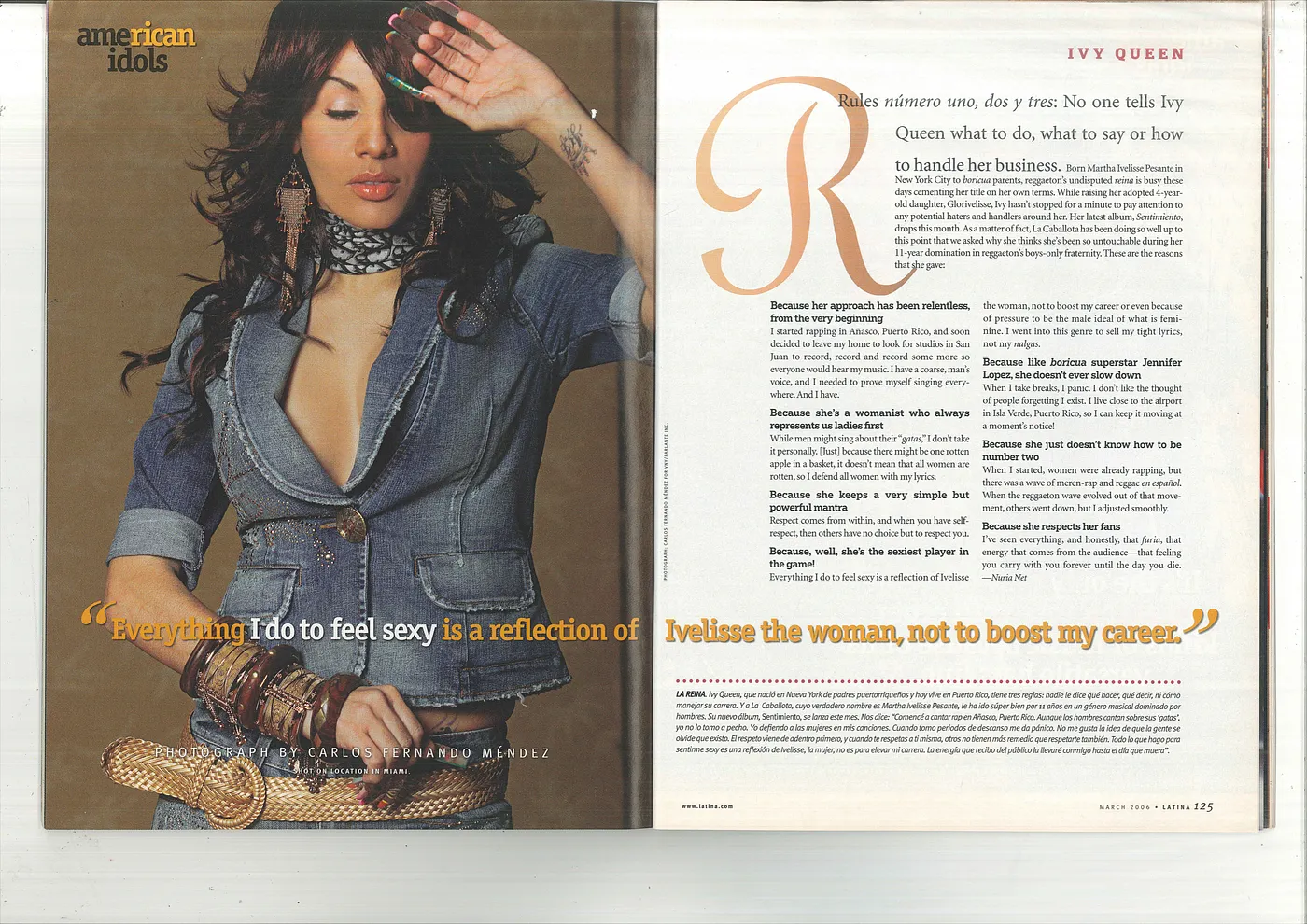
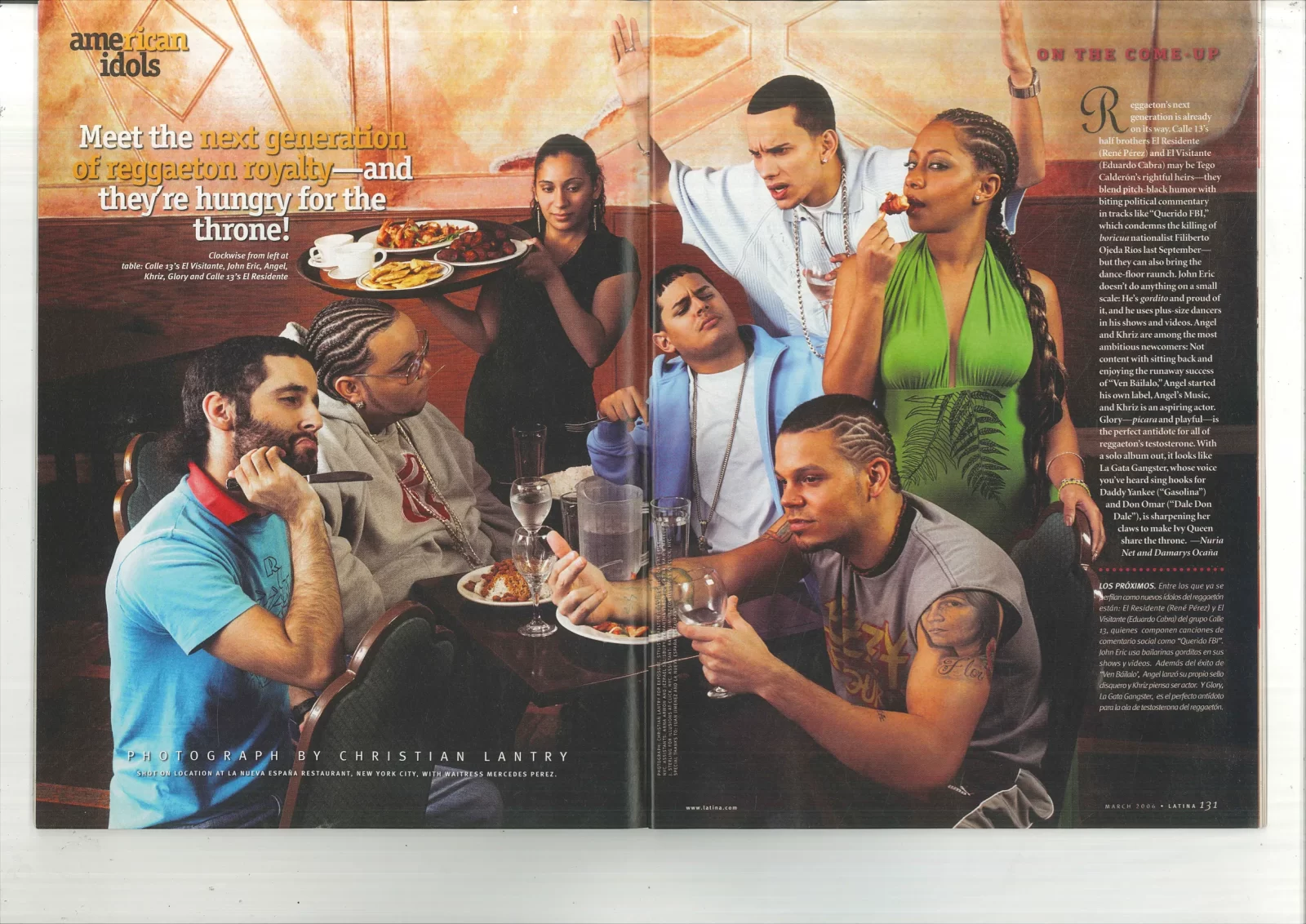
Latine journalists found places to cover reggaeton elsewhere. They wrote for public-facing academic journals, community papers like Claridad, independent magazines, and personal blogs. Hip hop periodicals like Vibe, Stress, In the House, and Beat-Down published some of the most important features on reggaeton at the beginning of this period. Then there were new commercial ventures like Latina, a glossy magazine, which started to cover our popular culture on a national scale.
Almost two decades later, writers from my generation would face a similar challenge. In the mid-2010s, we were also thinking critically about reggaeton in self-made, community-focused spaces: Latine-owned digital media outlets, independent podcasts, specific corners of Twitter and Instagram. Prestige publications had largely stopped covering the genre after its initial commercial surge in the mid-2000s, but we were still engaged with the music and the culture.
Around 2017, when reggaeton started revolutionizing the sound of pop music across the globe, mainstream magazines started paying attention again—and hiring us to write about it. Like the previous generation of writers, and reggaeton artists before us, we too had to navigate what it meant to be both participants in the culture and mainstream representatives of it.
* * *
The commercial ascent of reggaeton, and the mainstream writing about it, wouldn’t exist without hip hop. The mid-2000s were a prolific era for hip hop journalism—given their shared histories, it wasn’t long until national hip hop magazines started covering reggaeton.
In March 2004, the journalist Jesús Triviño, now Senior Director of Industry Relations and Global Latin at TIDAL, wrote a major scene profile on reggaeton for The Source. The piece addressed reggaeton’s rise on the U.S. charts but also explored its tension with traditional hip hop in Puerto Rico. At the time, plenty of Puerto Rican artists saw the sound as an artificial and empty trend which would never measure up to the seriousness of the craft and content of rap music. These debates made reggaeton a natural fit for hip hop magazines, not to mention the genres’ kindred origin stories as diasporic sounds entangled in loops of migration between the Caribbean and the East Coast of the United States.
Rivera moved to New York in 1994 for her doctorate degree and began contributing regularly to hip hop mags, including Stress, In the House, and Urban Latino. She wrote about police brutality in New York and the battle for the demilitarization of Vieques, but she also reviewed rap records such as Boricua Guerrero, a compilation that united industry heavyweights from both genres, including Nas, Daddy Yankee, Busta Rhymes, Q-Tip, and Don Chezina. While Rivera’s doctoral studies focused on Nuyorican hip hop culture, she was also writing for Puerto Rican magazines about reggaeton shows thrown in New York by recent Puerto Rican migrants. Rivera’s own writing on these genres, shaped and re-shaped by the movement of Puerto Ricans from New York to the archipelago and back again, mirrored the diasporic vaivén that gave birth to hip hop and reggaeton itself. She graduated in 2000 and published her first book, the landmark New York Ricans from the Hip hop Zone, in February 2003—continuing to cover the movement for Spanish-language newspapers like El Diario/La Prensa as the music gained commercial ground.
In November 2003, Rivera wrote a profile of Tego Calderón. A short, one-page interview for Vibe, this was an unprecedented moment for reggaeton within the pages of a national English-language music magazine. Still, Rivera struggled to reconcile her feelings around the genre’s success. “Here I am making all these arguments in the nineties,” she says. “Like…‘Yes, it’s misogynistic, but at the same time, banning the songs is not going to solve anything,’” she recalls, referencing Puerto Rican politicians’ call to censor this music. “The problem is not the music. The problem is the larger culture. And they’re making the music into the scapegoat.’ But, as time went by, there were many moments where I just had to stop and [wonder], do I still believe everything I’ve been saying? Do I still stand by the same thing?” she continues. “Throughout that decade that reggaeton was blowing up, I think my passion for it was also waning, except for certain artists that made me excited, like La Sista,” she adds. “The majority of people blowing up were not people like that. It had to do with Blackness, but it had to do with musical excellence and political commitments. “Why do the most interesting people get left out?”
At the time, reggaeton was facing a familiar cultural reckoning in popular music: the eternal conflict between art and commerce. Romero, formerly the Global Latin Content Lead at Amazon Music, wrote a narrative feature for Vibe called “Latin Kings” at the end of 2005, when she was an assistant music editor at the magazine. It traced the genre’s journey through the stories of two of its most beloved figures, Tego Calderón and Daddy Yankee, but also explored their divergent positions within the movement: one as the genre’s incisive social critic, the other its reigning businessman.
Romero remembers this tension between reggaeton’s imminent market dominance and its beginnings as a street sound feeling urgent at the time. “What does it mean to be commercially successful? Do you have to sell out? How do you maintain integrity?” she ponders. These questions would remain relevant over the next 20 years, as Calderón and Yankee’s careers evolved alongside the music: Calderón continued to play with bomba, salsa, and other Puerto Rican genres, while Yankee forayed into EDM and even Christian music—for better or worse. “There are natural fears or questions about how this is going to evolve,” concludes Romero, referring to reggaeton as a movement. “Will it continue to represent what it once did?”
Reggaeton became a timely topic for Vibe when rappers began collaborating with reggaeton artists, especially Puerto Ricans like Fat Joe and N.O.R.E. “When my article came out, it was an interesting situation of hip hop artists wanting to get a piece of the pie,” Romero says. The mechanics of the music industry manufactured a false kind of competition and distance between hip hop and reggaeton in the mid- 2000s, positioning them as art forms that had nothing to do with each other. But fans and followers of multiple generations knew that there was room for both genres in their lives, even if they couldn’t articulate the specifics of the political and sonic kinship between reggaeton and hip hop.
Raquel Cepeda, a Dominican writer, author, and filmmaker, sought to make that throughline visible. From 2001 to 2004, she was the editor-in-chief of Russell Simmons’ OneWorld, a glossy magazine that examined urban culture and hip hop as a global force. “I wanted to show an international perspective of how hip hop culture became the lingua franca for people all over the world,” she recalls. Cepeda got her start by writing poetry, meeting hip hop journalists and editors, and reading genre-defining voices like Greg Tate and Steven Hager. All of these threads—her poetic beginnings, the genre’s innate lyricism, the observational tenor of traditional news journalism—ended up sculpting her voice as a writer, too.
In March 2005, Cepeda wrote a scene profile on reggaeton for The Village Voice. Like others before it, the piece examined reggaeton’s relationship to hip hop. Cepeda says that her desire to contextualize these movements in relation to each other comes from a commitment to Pan-Africanism, and shared Afro-diasporic musical identity.
“They’re youth cultures created by kids who have nothing,” she says, of both genres. “Wherever I can find a commonality where we can come together—not in a dulcet or bubblegum way—I like that.” Both movements were criminalized by the state. Both have been chopped up, sped-up, re-worked, and sampled to infinity. And both genres are unafraid to revel in the taboos of sex, drugs, and partying. “I wanted to locate [reggaeton] for the reader, but I also wanted to show that when communities of color coalesce, they create powerful shit.”
Cepeda remembers how she fought to write experientially. “I started to educate myself on the line between new journalism and hip hop writing, where you put yourself in the center of the story,” she says, referencing Hunter S. Thompson as a model for that style. “We were doing the same thing when we got away with it.” She says it felt natural because hip hop had its own version of the journalist: the graffiti artist. “They wanted people to know their name, not their faces.” Like a byline. And like hip hop, reggaeton has always been a participatory genre—one without the traditional division between stage and crowd that characterizes so many other forms of popular music. Reggaeton critics are active participants in this culture, too—as dancers, documentarians, fans, thinkers, club kids. If the experiential is at the forefront of this music, it’s no surprise that its writing would take on those textures too.
Yet, like Cepeda, Rivera has also had to contend with the impulse against this style of writing in both scholarship and traditional journalism. “I had to learn the academic-y voice, but there’s another type of writing, like the article that I wrote for Vibe about Tego, that was such a pain in the ass. Because I just don’t know that formula,” she laughs. “I know what my natural writing voice is, it’s like this chronicle: I’ll tell you what I saw, I’ll tell you what happened, but somehow that’s not what the big magazines wanted.”
Consider this 1995 article Rivera wrote for The San Juan Star, a report about going to an underground show with a friend:
The concert began very late. It was scheduled to start at seven, but knowing how late these concerts usually start, Kahlil and I took our time. We spaced out while eating quenepas and scrambled eggs; that is why at ten we were still in Carolina. Thinking we had gone overboard, we hurried to Canóvanas to find a crowd hanging out at the coliseum’s entrance. People pranced around displaying and talking in hip hop style, isla del encanto version. In the midst of hugs, scowls, smiles and attitude we sighted slim braids, fat braids, dreads, knee-length polo shirts, Braves tank tops, tiny silver halter tops, humongous goldredgreen&black hats, frying pan-sized earrings, huge jeans perilously balanced on butt cracks, plastic mini-skirts, fades with stripes, stripeless fades, shineheads…With my studious blanquita face and Kahlil’s peculiar dirty blond, blue-eyed rasta look, we were quickly detected as oddities. But after a few curious glances, everyone went about their business and into the coliseum.
In 2026, that kind of narrative play feels like a hard-won prize. When an editor expects you to educate the reader on the basics—to recite the 30-year history of a genre every time you write about it—there’s little room left for pleasure or storytelling. Too often, you must adopt an explanatory register. In the process, you might inadvertently become a compliant emissary, trained to package, parse, and soften. Your reward: the rosy comfort of representation, the beguiling vocabulary of breaking barriers.
* * *
Over the last three decades, reggaeton and its journalism have undergone multiple reckonings. What does it mean to advocate for nuanced writing about reggaeton when you can’t make a living wage from it? Or when, as the only Spanish-speaking writer at a publication, you must take on the additional unpaid labor of talent booker, fact checker, and translator? It’s hard not to romanticize what seemed like the halcyon days of culture journalism, when freelance critics would be paid nearly $500,000 to write only three longform stories a year. When there was space, time, and money for outlets to hire multiple specialists, instead of a single (usually white male) pop music critic. When magazines finally started hiring people of the global majority. When we didn’t have to develop quirky online personas and loyal followings to catch the eye of an editor or a brand and pray they’d give us paid work.
And yet, so many of us writing about reggaeton today are still women, queer, and/or femme—still asking the same questions about gender, sexuality, ethnicity, and race that writers like Rivera did. For me, criticism will always be an act of love—a kind of care work that seeks to help the art we need get better. I’ve tried my hardest to explore reggaeton’s nuances considering the racist and classist prejudices it’s faced over three decades. I wonder, sometimes, if that has made me too permissive of artists’ missteps—their lazily misogynistic or homophobic comments, or their ignorance around anti-Blackness in their own countries. It’s no secret that reggaeton doesn’t always take care of us— the queers, the femmes, the freaks. In my efforts to defend this genre, I sometimes wonder if I should have gone harder against it.
But I want to believe that the critical labor we have done has shifted the music in some way. I want to believe that the collective work of documenting, witnessing, interrogating, and celebrating this genre has let us see more of its subtleties and contradictions, and made us more aware of its pliability and capacity for longevity. I want to believe that this new generation of writers and thinkers has begun to fracture the fixed definitions and narrow-minded fictions that have accompanied this genre for so long. If grinding through this industry for the last ten years has been worth anything, I want to believe we have at least helped bring critical thought around reggaeton to new, larger publics. We have given so much to this genre in the hope it will love us back, and I want to believe it’s starting to.
* * *
In the spring of 2020, about two weeks before the COVID-19 pandemic forced us into lockdown, Bad Bunny released his second album, YHLQMDLG. That night, after a group of writers and industry friends went to Toñita’s for a Remezcla party, I hosted an impromptu listening session of Benito’s record at my apartment. My friend Briana ordered a couple of bottles and a pizza, and texted her weed dealer to come over. Then she called her then-roommate to bring over the speakers I’d lent her for her birthday party the previous year. We pushed the hand-me-down armchairs and thrifted dining room table against the wall to make room for the guests that slowly started trickling in through the front door. And then, we hit play.
I remember us listening together, for the first time, cups of lukewarm Brugal in our hands, squealing in each other’s faces, shaking our asses for no one in particular. We started cackling, collectively, when we first heard it: si tu novio no te mama el culo, pa eso que no mame. While the ice in our drinks melted, Jowell y Randy instructed us to drink, to smoke, to perrear, God willing. We filmed our drunken glee for Instagram, 15-second videos of screamed lyrics and ayyyyyyys that came from the gut. One of the friends I invited that night, Jenni, stayed over, sleeping next to me because it was too far and too late to go back to Jersey. The following morning, I spread my hands out on the hardwood floor after everyone had gone home, the grime and sticky-sweet liquor stains leaving gluey traces on my palms.
In the days that followed, we got to work, describing, studying and researching the album. The architecture and business interests of music journalism might always seek to stifle and constrain, to move us toward critical distance, neutrality, and explication around reggaeton. But that night, the music told us to refuse. To say no to ordinariness and yes to joy and sex and pleasure and play. Reggaeton asks you to surrender to it, begs you to inhabit its cracks and fissures. And along the way, it demands that you—and the writing—move a little closer to the flesh.