


In Islam, Mecca is a fixed place you travel to—a physical pilgrimage to the house of God, a process of submission to your faith replete with rituals and fellowship. The Arabic etymology of the pilgrimage itself, hajj, is about setting an intention toward a definite objective: it is not enough just to arrive, you must also practice in mind, body, and spirit. Beyond an expression of fidelity, believers understand it as the ultimate act of solidarity; over six days, you rub shoulders with two to three million of your fellow adherents.
The idea of Harlem as the Black “Mecca” traces back to the Harlem Renaissance, when burgeoning literary and artistic luminaries migrated to upper Manhattan. In 1925, poet and editor Alain Locke described the neighborhood as a “race capital”: “Harlem, I grant you, isn’t typical, but it is significant, it is prophetic.”
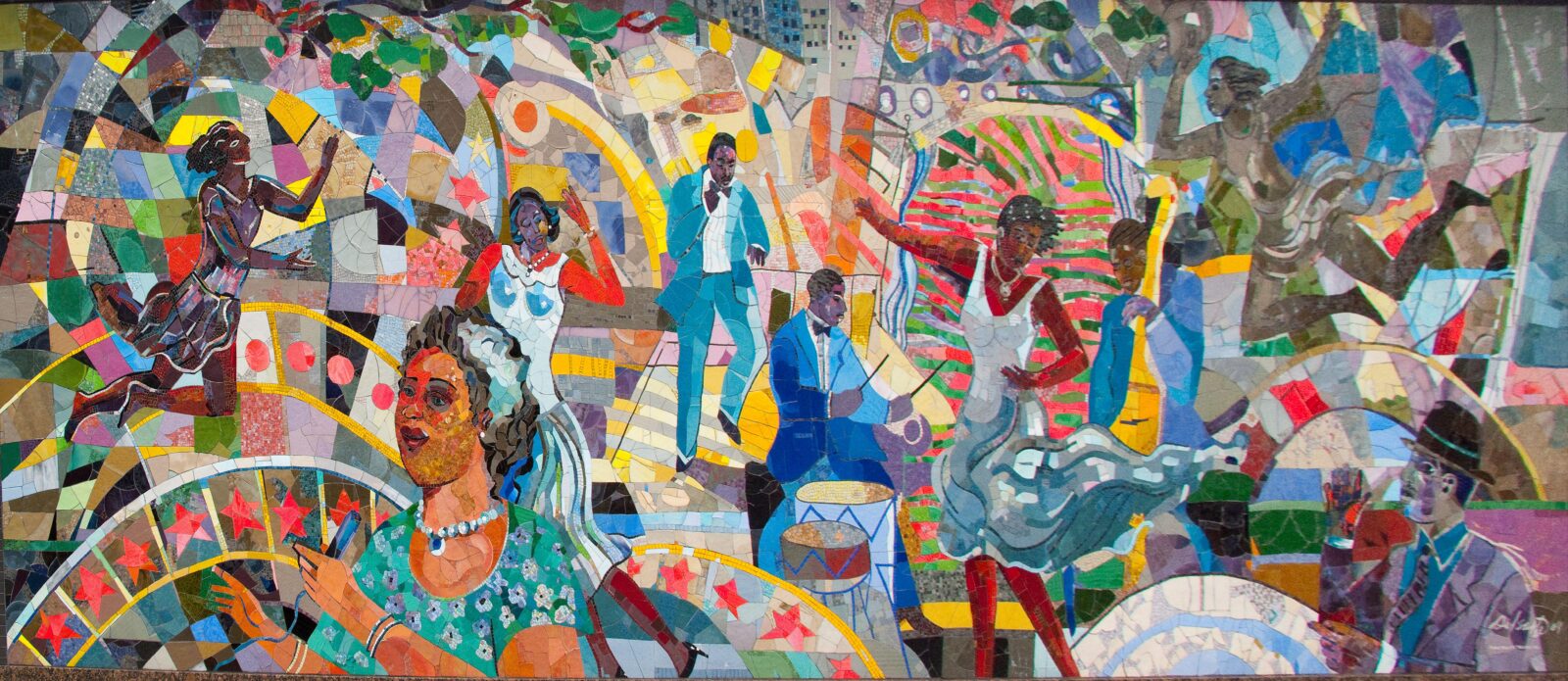
That prophecy, however, is more than the works of Langston Hughes, the famed salons of A’Lelia Walker, or the legendary performances at the Cotton Club and Apollo theater — all those vaunted literary communities and performance spaces of the Harlem Renaissance we tend to learn about in school. A century on, the neighborhood I have known intimately since childhood has always functioned as a kaleidoscopic prism through which uniquely Black cultural experiences are established, dissected, and reassembled for spectators and participants alike. The highbrow spaces may be what makes the history books, but culture drips from every corner, flowing up from the innovations of the working class.
So much of that innovation comes from constructing in absentia: communities turning on fire hydrants in the absence of proper playgrounds; numbers hustles and gambling rackets emerging as alternatives for Black people shut out of financial opportunities; tailors and designers like Dapper Dan reworking luxury textiles into accessible streetwear for the community. The spirit of the neighborhood as fertile ground for transformation and innovation has never been extinguished so much as reincarnated.
New eras allowed for new incarnations. As the nascent sport of basketball began to spread across urban enclaves through the rise of streetball in the ’50s and ’60s, Harlem made its mark as the epicenter of Black athleticism, sprouting famed basketball courts such as Kingdome and Rucker Park—so much so that a Chicago-based exhibition team chose to name themselves the “Harlem Globetrotters” to take on a mythic shine. In the ’80s and ’90s, as young teens in the neighboring South Bronx began to develop the musical form and subculture that would come to be known as hip hop, Harlem began to incubate its own contributions to a genre that would soon take over the world—adding a uniquely local sense of flash, performance, and theatrics that remains a hallmark of Harlem identity today. This was the backdrop for the birth of a new dance style in the early 2000s called litefeet—a marvel of athleticism, rhythm, and improvisation.
Litefeet first emerged from the blacktops of Harlem’s streetball scene, as part of the halftime entertainment. Staying true to hip hop’s legacy, emcees and DJs entertained rambunctious crowds as breakers and dancers moved to the music. Streetball MC and local legend AG, also known as the Voice of Harlem, was the first to coin the term “litefeet” to describe the improvised grace of athletes as they raced up and down the court. Over time, it also came to name the athleticism of the dancers themselves, whose movements were in conversation with the pacing and power of the sport, turning the court into their stage.
Street dancer Al B would entertain crowds at the famed Rucker Park’s Entertainer Basketball Classic with original dance moves — his most notable being a punctuated shimmy that sent his limbs akimbo in a display of speed, agility, and control. The dance move was originally called the “Albee” in his honor, but the moniker changed to the “Harlem Shake” when the dance became mainstream: New York City’s signature style.
So began a cycle of invention, adoption, and appropriation — both in the city and throughout the country. Dance moves such as the “Aunt Jackie” established at venues like Rucker Park or Kingdome, quickly became ubiquitous as trends moved from basketball courts to dance teams and social gatherings throughout Uptown New York City.
In cities throughout Black America, communities were finding ways to alchemize their novel metropolitan funk into regionally specific corporeal expression—from the deceptively deliberate fluidity of Washingtonians as they “beat their feet” at bustling go-gos to the dazzlingly frenetic syncopation of Chicago footwork—and Harlem USA was no exception to this phenomenon of metabolizing a rapidly changing urban grid into movement. The agility required to execute the movements with both flair and precision didn’t just reflect the quick-twitch motions of the hard courts—it drew on the same muscles and tendons needed to pivot through a humming crowd without interruption, flattening and expanding the space one’s body could occupy among the masses. Years of contorting the body to fit within an urban milieu—quick-paced strides matching the rhythm of the city, bobs and weaves to avoid collisions, maintaining balance on a crowded train—found new purpose in a burgeoning form of dance just as electric and fast-paced as any rush-hour commute.
As a lexicon developed for the body’s movements, a musical subculture grew in response, anchored by a clap-kick percussion combo that paired well with litefeet’s high BPM. Around the turn of the millennium—the tail end of hip hop’s “shiny suit era”—making your own version of a litefeet record was almost a prerequisite to being feted in the New York party scene. The rise of music empires such as Joaquin “Waah” and Darrin “Dee” Dean’s Ruff Ryders, and Sean Combs’s Bad Boy Records made the regional Uptown phenomenon national. Diddy—a Mount Vernon native with extensive family roots in Harlem—brought litefeet anthems to the charts with early 2000s singles like G.Dep’s “Let’s Get It,” for which the music video even featured the “Harlem Shake.” Soon these beats became the defining sound of artists and producers like Ron Browz, DJ Webstar, and Swizz Beatz.
Given this cultural legacy—spanning from hip hop’s early dance innovators to the basketball tournaments that gave them a space to shine—it comes as no surprise that litefeet is commonly associated with Black male performance. In New York, this is most visible in the phenomena of “Showtime” performers: collectives of teens and young adults, mainly men, who commit herculean feats of athleticism and choreography on trains, in parks, and throughout the city’s main tourist hubs.
Unbothered by the careening bustle of the subway system, dancers glide up and down the cars, flirting with danger and defying gravity as they invert their bodies on poles and suspend themselves in freezes mere inches away from seated passengers. The confrontational style is born from necessity rather than hostility. As city government slashes funding for hubs of youthful connection—recreation centers, low-cost dance classes, skating rinks—teens gather on streetcorners, scrambling for brief moments of community before being targeted by law enforcement for loitering.
In the absence of third spaces, Showtime registers as a kind of protest: teens chart their own paths through the hostile city, turning public transportation into a playground of exploration and fellowship. As always, context produces style: flip tricks with hats and shoes require minimal personal space, shuffle and bounce steps help dancers look dynamic while they stay in the same spot. It’s right there in the name—a new way to create spectacle from exclusion.
Municipal government is not the only agent of exclusion. Our own narratives also determine who takes the main stage and who gets left on the margins. Even as litefeet gains recognition in New York City’s cultural canon, I am left wondering: where are the ladies? While dancers like Al B and Chrybaby Cozie helped popularize the foundational movements, and producers and emcees established the core rhythms which undergird the dances, many of the high points of litefeet culture were anchored by young women who served as instructors, hypewomen, and cultural interlocutors over the booming percussion of its records.
Yet, they remain overlooked in discussions of litefeet’s legacy. One example is Harlem native Bianca Bonnie, formerly known as Young B, the commanding voice on many classic litefeet records. She was the breakout MC on DJ Webstar’s 2006 “Tone Whop,” a song named after an eponymous dance style, her naturally high voice adding a subversively delicate element to the production. Y’all like our style please don’t copy / like BET so just watch me, she trills, as dancers showcase the snap-shuffle-step combo that expands the body like a starfish before rapidly contracting.
Front and center in the dance circle is a young Teyana Taylor—a decade from breaking out internationally as a celebrated artist and choreographer—challenging the men as she contorts her body at different levels of elevation, and writhes and jerks in syncopation with the choppy bassline as a crowd of fellow teens cheered her on. Teyana’s enmeshment in this space would ultimately lend itself to one of her earliest professional opportunities as a dancer: choreographing the music video for Beyoncé’s “Ring the Alarm” at just 16 years old. How did the pair meet? The Destiny’s Child megastar first reached out to the Harlem teen to learn the “Chicken Noodle Soup.”
True to her lyrical affirmation, Bianca would soon find herself on BET, performing the chart-topping hit “Chicken Noodle Soup.” Let it rain, clear it out, she chants over rumbling drums and an unrelenting siren. She would soon follow that formula with the local hit “5000”. Where “Chicken Noodle Soup” was didactic, patiently leading listeners through the dance steps, “5000” was more of a teasing challenge. First, Young B runs us through every foundational dance move of the litefeet era. Then, when we’re good and sweaty, she dares us to try the gravity-defying drop reminiscent of ballroom’s famous “dips.” Her expectations aren’t high: Oh please, you can’t do the 5Gs, she taunts, with all the charismatic pride of a Harlem princess. Despite these iconic contributions, Young B’s legacy and impact remain largely underrated. In an interview with Billboard, she admits her frustration: “I’m a Black woman, and it’s a real thing that we have to work harder and overcome more obstacles”, she says. “And [some fans] feel like people just come in and take what we created.”
Retrospective discussion of litefeet tends to lionize producers and diminish the significance of the actual tracks—many of which are performed by women whose distinctive voices recruited the masses to what was once a local scene. In 2007, Harlem native Lil Mama came out with the bawdy hit “Lip Gloss,” an ode to teen girlhood that became a litefeet anthem in its own right. The a cappella interval canonized a now-iconic call-and-response: “No Music!,” she chants, followed by a syncopated clapping pattern. That same a cappella dance break has since become the backbone of many litefeet performances, with dancers occasionally asking onlookers to replicate that same 4-count rhythm to build momentum for their shows. Like so many Uptown styles, it’s a participatory art form born of necessity: if the music cuts off—a blown speaker, a fumbled aux cord, a neighbor’s noise complaint—the party can continue unabated, our bodies providing percussion and our voices providing anchoring chants so performers still have a rhythm to ride.
Soon after “Lip Gloss,” an unknown Queens MC by the name of Nicki Minaj would sample the very same beat for her mixtape: They say that girl is a fool, the girl keep on boppin’/ The girl get them girls and them girls get it poppin.’ In a tight couplet, Nicki reminds us that the girls are the ones who get the party started and keep it going, even when they don’t receive the respect they deserve.
Less than two years later, the girl they called a fool would dominate the mainstream with Pink Friday. Just before her major label debut, however, Nicki would return to Harlem’s deep well on her 2009 mixtape, Beam Me Up Scotty—laying new vocals over Ron Browz’ instrumental litefeet anthem “I Get Crazy.” Her approach to the track is unyielding and unapologetic, releasing the long-stigmatized aggression associated with New York women.
“I just came up out the motherfucking old school,” she declares with authority—in litefeet culture, aggression is not only welcome but required. Bronx native Remy Ma channels a similar energy on her debut album’s lead single “Whuteva,” barking orders over the frenetic sonics of Swizz Beatz. I ain’t gotta be boss just as long as I’m in charge. These records are brash and demanding: forget your demure two-step; now’s your chance to unleash the body’s pent-up frenzy. In a city where it can be hard to transcend your social limits—class, race, gender, neighborhood—litefeet offers an open arena to showcase your individuality without compromise.
But litefeet hasn’t always been about individuality, especially not for women. As the genre expanded out from Harlem through the city, collectives eclipsed particular stars: W.A.F.F.L.E. (We Are Family For Life Entertainment), Team Lifefeet, Litefeet Nation, and more recently, Shake Nation. Women’s voices remained essential, but obscured as part of the choral soundscape rather than celebrated as unique talents. Take DJ Webstar’s “All In”: a crowd of young women shout out the dance steps—swag in, swag out—while some rap the verses, but the only credit goes to the collective “Tune Nation.” This anonymity perpetuates a misguided narrative that litefeet is a space dominated by young men, often reduced to the Showtime train dancers. Their hypervisibility begets dual harm: the dancers themselves are subjected to surveillance and sanction, while their perceived ubiquity overshadows any deeper understanding of women as cultural anchors in the style.
With time, litefeet itself has faded from the center stage, but glimmers of its cultural resonance remain. On any given night, you may see the New York Liberty mascot Ellie the Elephant integrating litefeet choreography at halftime; hear a classic Drake record sped up and remixed to fit litefeet choreography; or see a DJ in Harlem or the Bronx break into a litefeet call-and-response to draw out the New York natives in the room. The history of litefeet is inextricable from the histories of hip hop, local basketball culture, and Harlem itself—oppressed New Yorkers coming together to create something unprecedented and distinct from the depths of neglect, turning the city’s margins into the city’s center.
Now, the ladies of litefeet are beginning to lay claim to the prophesied Black Mecca in their own ways. At this year’s Met Gala—a celebration of Black dandy tailoring, which has deep roots in Harlem—Teyana Taylor stood at the top of the red-carpeted stairs in a sweeping crushed velvet zoot suit. Almost 20 years after breaking into the musical scene and charting out her own Harlem legacy, she continues to remind the world over that she is Harlem’s rose, its greatest emissary.
But while the Met Gala offered a massive stage to celebrate the ways in which Harlem innovates, the annual African American day parade in Harlem is the local bellwether for what the community holds dear. Held every September, community leaders and organizations—the Masons, local dance teams, drumlines, advocacy groups, historically Black firehouses—parade down Adam Clayton Powell Boulevard while onlookers proudly wave their red, black, and green Pan-African flags.
Back home, Teyana Taylor presided over her beloved neighborhood in her personal chariot made by the Harlem Shake brand—now a burger and fries spot as well as a cultural movement—as “Chicken Noodle Soup” blared through the speakers. “I’m from Harlem and I wouldn’t want to be anyplace [else] in the world,” she crowed to the audience, and they responded with raucous applause. “We start everything, and the world follows.” She’s confident in the knowledge that Harlem’s greatest legacy is its consistent ability to remake itself, creating charismatic spectacles out of the most restrictive circumstances. And while the world may have moved on, in Harlem, litefeet is forever.